How to Find Businesses for Sale That Aren't Listed (Off-Market Deals)
The Deals That Never Get Listed (And How to Find Them First)
If you have spent any time on BizBuySell, BizQuest, or other marketplace sites, you have noticed the same problem every serious buyer notices: the best businesses are not there. Learning how to find businesses for sale not listed on public marketplaces is the single highest-leverage skill in acquisition entrepreneurship — and the one nobody teaches you.
The International Business Brokers Association (IBBA) estimates that only 20-30% of small business transactions are publicly listed on marketplaces. The remaining 70-80% change hands through private channels — referrals, direct outreach, professional networks, and quiet conversations between owners and buyers who found them first.
This is not a niche phenomenon. It is the default. The majority of businesses sell without ever appearing on a marketplace listing. And the reasons are straightforward: owners do not want employees, customers, or competitors to know the business is for sale. They do not want tire-kickers. They do not want their phone ringing off the hook from unqualified buyers who will waste three months of their time and never close.
The best acquisition targets are never listed. They are found by buyers who build systems to surface them before anyone else knows they are available.
If you are competing for deals on public marketplaces, you are competing against every other buyer with an internet connection and a search alert. If you are sourcing off-market, you are competing against almost nobody.
This guide introduces the Off-Market Deal Sourcing Funnel — a systematic framework for building repeatable deal flow from seven proven channels — and walks through the exact tactics for each one.
Why Off-Market Deals Are Better Deals
Before we get into the how, let us be clear about the why. Off-market deals are not just more available — they are structurally better across nearly every metric that matters to a buyer.
Lower purchase multiples. When a business is not being marketed to hundreds of buyers, the seller does not have competitive tension driving the price up. Off-market deals in the $500K to $5M range typically trade at 0.5x to 1.0x lower SDE multiples than comparable listed businesses, according to BizBuySell market data.
More flexible deal structures. Sellers who are not working with a broker are often more open to creative structures — seller financing, earnouts, equity rollovers, and transition consulting agreements. Brokers typically push for clean, all-cash or SBA-financed deals because those close faster and maximize the broker's commission.
Less competition. A well-marketed listing on BizBuySell might receive 50 to 200 inquiries. An off-market approach to an owner who has not formally decided to sell might receive one: yours. When you are the only buyer at the table, negotiation dynamics shift dramatically in your favor.
Better information flow. Owners who sell through brokers are coached on what to share and when. Owners who sell directly tend to be more transparent because the relationship is personal — you are not a faceless buyer number. You are the person who sat across from them at their own conference table and asked about their business.
Longer transition support. Off-market sellers tend to offer longer and more committed transition periods. They care about what happens to their employees and customers after the sale. This matters — a lot — in businesses where relationships and operational knowledge drive value. For more on why transition planning matters, see our guide on the first 90 days after buying a business.
The Off-Market Deal Sourcing Funnel
Most buyers approach off-market sourcing as a random, opportunistic activity. They hear about a deal from a friend, follow up on it, and if it does not work out, they go back to waiting. This does not scale.
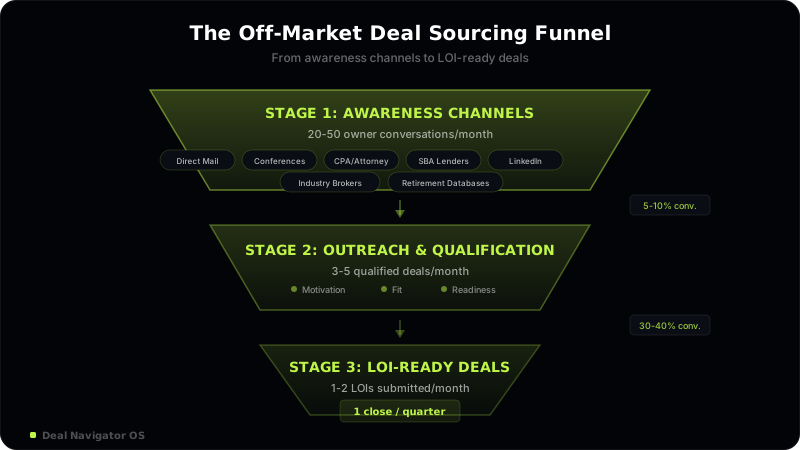
The Off-Market Deal Sourcing Funnel systematizes the process into three stages, each with clear activities and conversion metrics.
Stage 1: Awareness Channels (Top of Funnel)
This is where you generate raw leads — business owners who might be open to selling, even if they have not formally decided to. The goal is volume with basic targeting. You are casting a wide net across seven distinct channels, each with different strengths and conversion characteristics.
Your target output from Stage 1 is 20 to 50 owner conversations per month across all seven channels combined. This is achievable once the systems are built. It is not achievable if you are doing everything manually and ad hoc.
Stage 2: Outreach and Qualification (Middle of Funnel)
Raw leads become qualified prospects through structured conversations. You are evaluating three things in every initial conversation:
-
Motivation. Is the owner genuinely open to selling, or are they just curious about what their business is worth? Look for life-event triggers: retirement within 2-3 years, health issues, partnership disputes, burnout, or desire to pursue something new.
-
Fit. Does the business match your acquisition criteria? Revenue range, industry, geography, owner-dependency, growth trajectory. Do not try to force-fit businesses that do not match. There are plenty of deals — discipline on fit is what separates serial acquirers from one-and-done buyers who overpay.
-
Readiness. Can this owner actually complete a transaction? Do they have clean financials, a clear legal structure, and no partnership disputes or pending litigation that would block a sale? These are the same items covered in a comprehensive due diligence checklist.
Your target conversion from Stage 2 is 3 to 5 qualified deals per month from 20-50 conversations.
Stage 3: LOI-Ready Deals (Bottom of Funnel)
Qualified deals receive a preliminary valuation and a letter of intent. This is where you formalize the relationship and move into exclusivity. For the mechanics of this stage, see our guide on how to write a letter of intent for a business acquisition.
Your target output from Stage 3 is 1 to 2 LOIs submitted per month. At that pace, you should close 2 to 4 acquisitions per year, depending on your deal criteria and financing strategy.
The 7 Off-Market Deal Sourcing Channels
Each channel below is ranked by effort-to-start, time-to-first-deal, and scalability. No single channel will produce enough deal flow on its own. The compounding effect comes from running all seven simultaneously.
Channel 1: Direct Mail to Business Owners
Effort to start: Medium | Time to first deal: 3-6 months | Scalability: High
Direct mail is the workhorse of off-market deal sourcing. It is boring, it is old-school, and it works. Response rates run 1-3% for well-targeted campaigns, which means you need to send 200-500 letters to generate 5-10 conversations.
How to build the list. Start with your target criteria: industry, geography, revenue range, and owner age. You can build lists from state business registrations, industry association directories, and commercial data providers like Dun & Bradstreet or InfoUSA. For owner age — a critical variable for retirement-motivated sellers — cross-reference with property records and LinkedIn profiles.
What the letter should say. The letter is not a sales pitch. It is a respectful, direct introduction. Here is the structure that converts:
- Paragraph 1: Who you are and why you are writing. Be specific about the industry and geography. "I am actively acquiring [industry] businesses in [metro area]" is infinitely more compelling than "I am interested in buying a business."
- Paragraph 2: Why their business caught your attention. Reference something specific — their reputation, their longevity, their market position. This is not flattery. It is proof that you did your homework.
- Paragraph 3: What you are offering. A confidential, no-obligation conversation about their long-term plans for the business. Emphasize that you are not a broker, you are a direct buyer, and the conversation is completely private.
- Paragraph 4: How to respond. Phone number, email, and a specific call-to-action. "If you would be open to a 15-minute conversation, I am available Tuesday and Thursday mornings" works better than "Please feel free to reach out at your convenience."
Follow-up cadence. Send the initial letter. Follow up with a second letter 3 weeks later. Follow up with a phone call 2 weeks after that. Most responses come from the second or third touch, not the first.
Channel 2: Industry Conferences and Trade Shows
Effort to start: Low | Time to first deal: 6-12 months | Scalability: Medium
Industry conferences are where owners gather, and where conversations about "what's next" happen naturally. You are not pitching at conferences. You are networking, listening, and identifying owners who are thinking about their exit.
The most productive conferences are industry-specific trade shows in fragmented industries — HVAC, plumbing, pest control, landscaping, auto body, dental practices. These industries have thousands of independent operators, many approaching retirement age, with businesses valued between $500K and $5M. The SCORE.org small business mentorship network maintains a calendar of regional business events that often surface these opportunities.
What to do at the conference. Attend sessions on succession planning, retirement, and "what's next for your business." These sessions self-select for owners who are already thinking about selling. Introduce yourself as a buyer — not a broker, consultant, or "advisor." Owners respect directness. Ask one question: "Have you thought about what your plan is for the business in the next 3-5 years?"
Channel 3: CPA and Attorney Referral Network
Effort to start: High | Time to first deal: 6-12 months | Scalability: High
Every business owner has a CPA and an attorney. When they decide to sell, the CPA and attorney are the first people they call — before they call a broker. If you are in the CPA's referral network, you hear about the deal before it hits the market.
How to build the network. Identify 15-20 CPAs and business attorneys in your target geography who specialize in small business clients. Take them to lunch. Explain exactly what you are looking for: industry, size, geography, deal structure. Ask them to think of you when a client mentions selling.
The referral incentive. Most CPAs and attorneys will refer organically because it serves their client's interest. But you can accelerate referrals with a simple commitment: "If you refer a deal that closes, I will keep you as the business CPA/attorney post-acquisition, and I will pay a $5,000-$10,000 referral fee." This is standard practice and completely legal in most jurisdictions.
Why this channel compounds. A CPA with 200 small business clients will see 5-10 of those clients consider selling every year. One strong CPA relationship can generate 2-3 qualified leads per year indefinitely. Build 10 of those relationships and you have a pipeline.
Channel 4: SBA Lender Introductions
Effort to start: Medium | Time to first deal: 3-6 months | Scalability: Medium
SBA-preferred lenders see deal flow from the other side of the table. When a seller approaches a bank about the sale process, or when another buyer's financing falls through, the lender often knows about businesses that are available before anyone else. For a deep dive on SBA financing, see our SBA loan guide for business acquisitions.
How to build lender relationships. Identify 5-10 SBA-preferred lenders in your market who specialize in acquisition financing. Get pre-approved for a loan amount range. This serves two purposes: it makes you a credible buyer when deals surface, and it gives the lender a reason to send deals your way — they want to deploy capital.
What to ask your lender. "Do you ever see deals where the original buyer's financing fell through?" and "Do sellers ever approach you directly about the sale process before listing?" Both happen regularly, and lenders are happy to make introductions when they have a pre-approved buyer ready to move.
Channel 5: LinkedIn Outreach
Effort to start: Low | Time to first deal: 2-4 months | Scalability: High
LinkedIn Sales Navigator lets you filter by industry, company size, geography, years in role, and seniority. This means you can identify owners of businesses that match your acquisition criteria and reach out directly.
How to target. Filter for founders, owners, and CEOs in your target industry and geography who have been in their role for 15+ years. Long tenure correlates strongly with retirement motivation — these are the owners who have been running their business for two decades and are starting to think about what comes next.
The outreach message. Keep it short — under 100 words. The structure:
- "I noticed you have been running [company name] for [X years] — that is an impressive track record."
- "I am an acquisition entrepreneur focused on [industry] in [geography]."
- "I am not a broker. I buy and operate businesses directly."
- "Would you be open to a brief conversation about your long-term plans for the business?"
Response rates on LinkedIn outreach run 5-15% when the message is personal and the targeting is tight. That means 100 outreach messages should generate 5-15 conversations.
Volume cadence. Send 10-15 personalized messages per day. This is a 30-minute daily activity that compounds over time. After 90 days, you will have reached 900+ owners and generated 50-100 conversations.
Channel 6: Industry-Specific Business Brokers
Effort to start: Low | Time to first deal: 1-3 months | Scalability: Medium
Wait — isn't this guide about finding businesses that are not listed? Yes. But industry-specific brokers operate differently from marketplace brokers. A broker who specializes in dental practices, HVAC companies, or laundromats often has "pocket listings" — deals that are never publicly marketed. For a detailed example of industry-specific valuation, see our guide on how to value a laundromat.
How to find them. Search the IBBA member directory filtered by industry specialty. Look for brokers with transaction histories of 10+ deals in a single vertical. These are the specialists who have earned trust from sellers in that industry.
How to get pocket listings. The broker needs to trust that you are a real buyer who can close. This means:
- Share your acquisition criteria in writing
- Provide proof of funds or SBA pre-approval
- Follow up consistently (monthly check-in call)
- When they send you a deal, respond within 24 hours with substantive questions — not "let me think about it"
Brokers send their best deals to buyers who are responsive, qualified, and easy to work with. If you earn that reputation with 5-10 industry-specific brokers, you will see deals that never appear on any public marketplace.
Channel 7: Owner Retirement Databases and Succession Planning Lists
Effort to start: Medium | Time to first deal: 3-9 months | Scalability: Medium
Several states and economic development organizations maintain databases of business owners who are planning for succession. The SBA's succession planning resources connect owners approaching retirement with potential buyers. State Small Business Development Centers (SBDCs) frequently maintain informal lists of owners who have expressed interest in selling.
How to access these. Contact your regional SBDC, state economic development office, and local SCORE chapter. Many of these organizations run "business transition" or "succession planning" workshops. Attending these workshops puts you in the same room as owners who are actively planning their exit.
Additional sources. Baby boomer business owner data is available through commercial databases. The demographics are compelling: approximately 2.3 million small businesses in the United States are owned by people over 55, according to the Census Bureau's Annual Business Survey. The SCORE mentorship program often pairs retiring owners with potential buyers — position yourself as a buyer-mentee.
The First Call: What to Say When an Owner Responds
The initial conversation is the highest-stakes moment in the sourcing process. Get it wrong and the owner shuts down permanently. Get it right and you have a qualified prospect who trusts you enough to share financials.
The first 5 minutes. Thank them for responding. Ask about the business — how long they have owned it, what they enjoy about it, what keeps them up at night. Do not talk about price, terms, or deal structure. You are building rapport and gathering information.
The qualification questions. After 10-15 minutes of open conversation, transition to qualification:
- "Have you given any thought to what the next chapter looks like for you personally?"
- "If the right buyer came along — someone who would take care of your employees and customers — is that something you would consider?"
- "Have you had the business valued, or would that be something worth doing?"
- "What is most important to you in a transition — price, terms, timeline, or finding the right fit?"
The close. If the owner is motivated and the business fits your criteria, propose a next step: "I would love to learn more about the business. Would you be open to a second conversation where we go a bit deeper into the financials and operations?" If they agree, you have a qualified lead.
What not to do. Do not make an offer on the first call. Do not ask to see financials on the first call. Do not bring up SBA loans, earnouts, or deal structures. The first call is about trust and qualification — nothing else.
Building the System: From Random to Repeatable
The difference between a buyer who closes one deal in two years and a buyer who closes one deal per quarter is not talent. It is systems. Here is how to operationalize the seven channels into a repeatable deal sourcing machine.
Week 1-2: Foundation. Define your acquisition criteria in writing — industry, geography, revenue range, SDE range, deal structure preferences. Get SBA pre-approved. Build your target list for direct mail (200+ owners). Create your LinkedIn Sales Navigator filters.
Week 3-4: Channel activation. Send your first direct mail batch (100 letters). Start LinkedIn outreach (10-15 messages per day). Identify and contact 10 industry-specific brokers. Schedule 5 CPA/attorney lunches.
Month 2-3: Scaling. Send second direct mail batch with follow-up letters to non-responders. Attend your first industry conference. Meet with 3-5 SBA lenders. Contact your regional SBDC about succession planning resources.
Month 4+: Compounding. By now, all seven channels should be active and producing conversations. Your CPA and attorney network will start generating inbound referrals. Your broker relationships will produce pocket listings. Your direct mail and LinkedIn outreach will generate a steady flow of owner conversations.
Track everything. Every outreach, every conversation, every follow-up goes into a CRM. You need to know your conversion rates by channel so you can double down on what works and cut what does not. The target funnel metrics:
| Stage | Volume | Conversion |
|---|---|---|
| Outreach touches (all channels) | 200-500/month | — |
| Owner conversations | 20-50/month | 5-10% of touches |
| Qualified prospects | 3-5/month | 10-15% of conversations |
| LOIs submitted | 1-2/month | 30-40% of qualified |
| Deals closed | 1 per quarter | 50% of LOIs |
Common Mistakes in Off-Market Sourcing
Mistake 1: Going too wide on criteria. If you are willing to buy "any profitable business in any industry," you will never build the industry expertise and referral network that produces the best deals. Pick 2-3 industries and go deep.
Mistake 2: Giving up after the first touch. Most deals come from the third, fourth, or fifth interaction with an owner. The owner who said "not interested" six months ago may call you next year when their business partner has a health scare. Stay in touch.
Mistake 3: Leading with price on the first call. The fastest way to kill a deal is to ask "what are you looking for?" on the first conversation. Owners who have not formally listed have not anchored to a price. Once they anchor, the negotiation dynamics change. Let valuation come later, after trust is established.
Mistake 4: Neglecting the follow-up system. Sourcing without a CRM is like fishing without a net. You will have great conversations, forget to follow up, and lose deals to buyers who were less qualified but more organized.
Mistake 5: Treating brokers as adversaries. Industry-specific brokers are allies, not gatekeepers. The buyers who treat brokers well get first calls on the best pocket listings. The buyers who try to go around brokers get blacklisted.
Frequently Asked Questions
What percentage of businesses sell off-market?
Industry data from the IBBA suggests that 70-80% of small business transactions occur without a public marketplace listing. This includes deals through brokers with pocket listings, direct buyer-to-seller transactions, and sales facilitated through professional networks like CPAs and attorneys. The smaller the business, the more likely it is to sell off-market — businesses under $1M in revenue rarely appear on BizBuySell.
How do I approach a business owner about buying their business?
Lead with respect and specificity. Identify the business by name, explain why it caught your attention, and be transparent about who you are — a direct buyer, not a broker. The initial outreach should be a short, professional letter or LinkedIn message proposing a 15-minute conversation with no obligations. Never cold-call an owner and open with "I want to buy your business." Start with "I am curious about your long-term plans" and let the conversation develop naturally.
Is it better to buy through a broker or direct?
Both paths have advantages. Brokers provide deal flow, help with valuation, and manage the seller relationship — but they add 8-12% to the transaction cost. Direct deals eliminate the broker fee and often allow for more creative deal structures — but you take on the full burden of sourcing, qualification, and negotiation. The best acquisition entrepreneurs use both channels simultaneously. Industry-specific brokers with pocket listings are particularly valuable because they combine the deal flow benefits of a broker with the reduced competition of off-market sourcing.
How long does it take to find an off-market deal?
With all seven channels active, expect 3-6 months from system launch to your first LOI submission. The first 60 days are infrastructure — building lists, establishing broker relationships, getting SBA pre-approved, and starting outreach. Months 3-4 are when conversations start converting to qualified prospects. By month 6, the system should be producing 3-5 qualified deals per month consistently.
What is the best CRM for tracking deal flow?
Any CRM that you will actually use consistently. For solo acquisition entrepreneurs, Airtable or Notion work well because they are flexible enough to track the full funnel without enterprise complexity. The critical fields to track: owner name, business name, industry, estimated revenue, channel source, last contact date, next follow-up date, and pipeline stage (lead, conversation, qualified, LOI, due diligence, closed).
From Deal Flow to Deal Closed
Finding businesses for sale that are not listed is not a hack or a secret. It is a system — seven channels, a qualification framework, and a follow-up cadence that compounds over time. The buyers who win off-market deals are not smarter or better connected. They are more systematic.
The Off-Market Deal Sourcing Funnel gives you the framework. The seven channels give you the tactics. The only remaining variable is execution.
If you are building an acquisition pipeline and want to track your deal sourcing funnel, qualification criteria, and LOI pipeline in one system, BuyBox was built for exactly this workflow — from first outreach to closing table.
Brandon Quijano
Acquisition strategist & builder of BuyBox