Business Acquisition Due Diligence Checklist: The Complete Guide
The Due Diligence Checklist That Separates Smart Acquisitions from Expensive Mistakes
Between 70% and 90% of all acquisitions fail to create value, according to a landmark Harvard Business Review study. Of those failures, nearly a third trace back to one root cause: inadequate due diligence. When you are using a due diligence checklist for a business acquisition in the $500K to $10M range, the margin for error is zero — this is your life savings, your SBA loan, and your family's future on the line.
This guide is the framework I use to evaluate every small business deal. It is organized into what I call the 5-Layer DD Stack — a systematic methodology that ensures nothing falls through the cracks, whether you are buying a laundromat or a SaaS company.
Why Most Due Diligence Fails (And How to Fix It)
The SBA reports that only 48.9% of small businesses survive past five years. When you acquire a business, you inherit every problem the seller forgot to mention — and a few they actively hid.
But here is the thing most guides will not tell you: due diligence failure is not about missing items on a checklist. It is about checking the wrong things in the wrong order.
Most first-time buyers spend 80% of their time on financials and 20% on everything else. The data shows the opposite allocation is closer to correct. Financial fraud is easy to catch with a good CPA. What kills deals is the stuff that does not show up on a balance sheet — customer concentration, operator dependency, lease landmines, and team dysfunction.
The best deal you will ever do is the bad deal you walked away from. Due diligence is not about confirming what you want to believe. It is about finding the reasons to say no — and then deciding to say yes anyway because nothing disqualified the business.
The 5-Layer DD Stack: A Framework for Systematic Due Diligence
Most due diligence guides hand you a flat checklist. The problem is that a flat checklist treats "verify tax returns" and "assess customer concentration risk" as equals. They are not. Some findings kill deals instantly. Others are negotiation points. And some only matter after you have confirmed the fundamentals.
The 5-Layer DD Stack organizes due diligence into five layers, each building on the one before it. You do not advance to the next layer until the current one clears. This prevents you from wasting $30,000 on legal and operational diligence for a business whose financials do not hold up.
Layer 1: Financial Foundation → Can this business actually support the acquisition debt? Layer 2: Legal Structure → Is the business legally clean and transferable? Layer 3: Operational Reality → Can this business run without the current owner? Layer 4: Revenue Quality → How durable and diversified is the income? Layer 5: Team and Culture → Will the people who make this business work stick around?
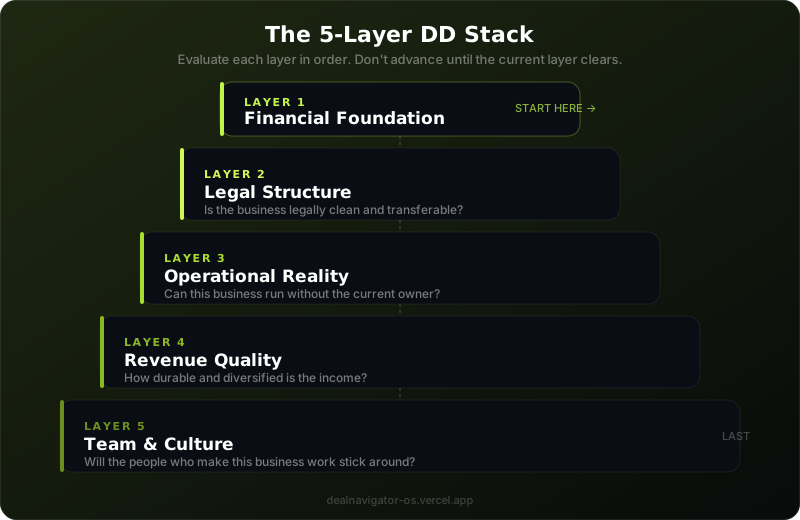
If a deal fails Layer 1, you save yourself the time and money of Layers 2-5. If it passes all five, you have high confidence the acquisition will perform as modeled.
Layer 1: Financial Due Diligence
Financial analysis is where most deals die — and where they should. If the numbers do not hold up, nothing else matters. For a deeper dive into valuation methods, see our guide on how to value a small business.
| Item | What to Verify | Red Flag Threshold |
|---|---|---|
| Tax returns (3 years) | Match reported revenue to bank deposits | Variance greater than 5% |
| Profit and loss statements (3 years) | Trend analysis, margin consistency | Declining margins 2+ consecutive years |
| Balance sheet | Asset valuation, liability completeness | Unrecorded liabilities of any size |
| Bank statements (12-24 months) | Cash flow patterns, deposit verification | Revenue claims not supported by deposits |
| Accounts receivable aging | Collectibility of outstanding invoices | More than 20% over 90 days |
| Accounts payable aging | Outstanding vendor obligations | Significant past-due balances |
| Debt schedule | All loans, lines of credit, obligations | Undisclosed debt |
| Seller discretionary earnings (SDE) | Validate every add-back with documentation | Add-backs exceeding 40% of net income |
| Working capital analysis | Normalized working capital requirements | Seasonal cash gaps requiring bridge financing |
| Capital expenditure history | Deferred maintenance, upcoming replacements | CapEx artificially suppressed to inflate earnings |
The SDE Reconstruction Test
This is the single most important financial exercise in any small business acquisition. Do not rely on the seller's SDE calculation. Reconstruct it yourself.
- Start with the tax return net income (not the P&L — tax returns are harder to fabricate)
- Add back only the add-backs you can verify with documentation: owner salary, owner benefits, one-time expenses, non-cash charges
- Cross-reference every month of deposits against reported revenue for the last 36 months
- Calculate the variance. If reconstructed SDE differs from the seller's claimed SDE by more than 10%, you have a problem
According to BizBuySell's 2025 Insight Report, the median small business sold for $350,000 at a cash flow multiple of roughly 2.5x. That means a $50,000 overstatement of SDE translates to $125,000 of overpayment. This is why reconstruction matters.
Financial Red Flags That Should Make You Walk
- Revenue declining quarter-over-quarter while the seller claims "growth potential"
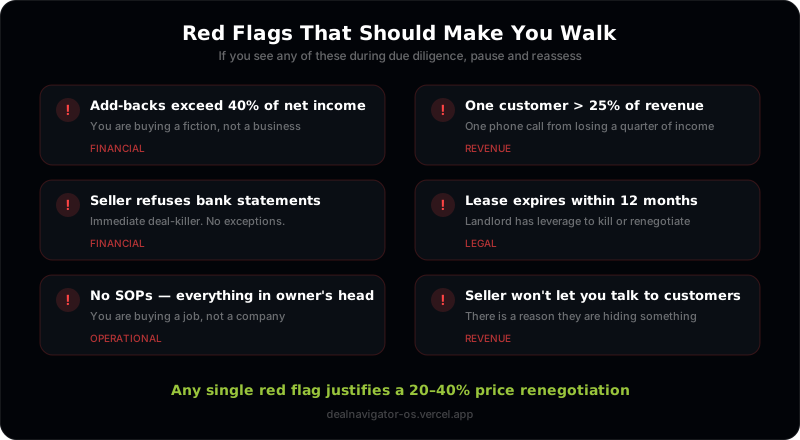
- Add-backs that exceed 40% of reported net income — at that point, you are buying a fiction
- The seller will not provide bank statements — this is an immediate deal-killer
- Inventory valued at retail instead of cost or liquidation value
- Personal expenses running through the business beyond what is disclosed — check credit card statements for personal charges coded as business expenses
Layer 2: Legal Due Diligence
Legal issues are binary. A clean legal profile lets the deal proceed. A messy one either kills it or requires a significant price adjustment. Whether you structure the deal as an asset purchase or stock purchase has major tax implications that your attorney should address early.
| Item | What to Verify | Red Flag Threshold |
|---|---|---|
| Entity formation documents | Proper incorporation, good standing | Lapsed registrations or compliance issues |
| Contracts and agreements | Assignability, change of control clauses | Key contracts not assignable without consent |
| Litigation history | Past, pending, and threatened actions | Any active lawsuit with damages exceeding $50K |
| Intellectual property | Ownership verification, registrations | IP owned by individuals, not the entity |
| Permits and licenses | Current status, transferability | Non-transferable licenses critical to operations |
| Lease agreements | Terms, renewal options, assignment rights | Lease expiring within 12 months with no renewal |
| Insurance policies | Coverage adequacy, claims history | Pattern of repeated claims in same category |
| Regulatory compliance | Industry-specific requirements | Outstanding violations or pending inspections |
| Environmental liabilities | Phase I assessment if real estate involved | Any known contamination or remediation |
| Non-compete agreements | Scope and enforceability for the seller | Seller unwilling to sign a reasonable non-compete |
The Lease Trap
If the business operates from leased space, the landlord must approve the ownership transfer for SBA 7(a) financing. I have seen landlords kill deals by refusing lease assignment or demanding above-market rent renegotiation. Check the lease assignment clause before you spend a dollar on due diligence.
Key lease items to verify:
- Remaining term: Less than 5 years remaining? Your SBA lender may require an extension
- Personal guarantee: Does the lease require one, and does it transfer?
- Exclusivity clauses: Can the landlord lease to a competitor in the same complex?
- CAM charges: Are common area maintenance charges capped or uncapped?
Legal Deep-Dive Items
- Have your attorney review every contract with a customer or vendor generating more than 5% of revenue
- Confirm that business name, domain names, social media accounts, and trademarks are owned by the entity — not the seller personally
- Review any past or pending government audits, especially sales tax and payroll tax
- Verify all employee and independent contractor classifications are correct — misclassification liability transfers to you
- Check for any guarantees or warranties the business has issued that create future liability
Layer 3: Operational Due Diligence
This layer separates real businesses from owner-dependent jobs. If the owner IS the business — handling sales, key relationships, and tribal knowledge — you are buying a very expensive job, not a company.
| Item | What to Verify | Red Flag Threshold |
|---|---|---|
| Standard operating procedures | Documented, current, complete | Critical processes exist only in the owner's head |
| Technology stack | Systems, software, integrations | Legacy systems requiring immediate replacement |
| Vendor relationships | Key suppliers, terms, alternatives | Single-source dependency for critical inputs |
| Facility condition | Physical inspection, equipment status | Deferred maintenance exceeding $50K |
| Supply chain | Lead times, reliability, alternatives | Supply disruptions in the last 12 months |
| Quality control | Defect rates, return rates, complaints | Return rate above industry average |
| Inventory management | Turnover rates, obsolescence risk | Slow-moving inventory exceeding 25% of total |
| Scalability assessment | Capacity utilization, growth constraints | Operating above 85% capacity with no expansion |
The Owner Dependency Test
Ask yourself this question: If the owner disappeared tomorrow, would this business generate the same revenue in 90 days?
If the answer is no, you need to understand exactly what the owner does that nobody else can do — and build a transition plan that transfers that capability to you or your team before closing. For a step-by-step guide to managing this transition, see the first 90 days after buying a business.
Operational deep-dive items:
- Spend two to three full days on-site observing operations during normal business hours
- Map the critical path: identify every process that breaks if the owner disappears
- Evaluate the technology stack age and budget $25K-$75K for modernization in the first 18 months
- Interview three to five key vendors off the record to understand relationship quality and payment history
- Document every system login, subscription, and third-party service the business depends on
Layer 4: Customer and Revenue Due Diligence
Revenue quality matters more than revenue quantity. A business doing $2M with 200 diversified customers is worth significantly more than one doing $3M with five customers — because the second business is one phone call away from losing a third of its revenue.
| Item | What to Verify | Red Flag Threshold |
|---|---|---|
| Customer concentration | Revenue distribution across top customers | Any single customer exceeding 15% of revenue |
| Revenue by type | Recurring vs one-time, product vs service | More than 70% one-time revenue with no pipeline |
| Customer acquisition cost | Marketing spend relative to new customers | CAC increasing quarter over quarter |
| Churn rate | Monthly and annual customer attrition | Monthly churn above 3% for subscription models |
| Net revenue retention | Expansion revenue from existing customers | NRR below 90% |
| Customer satisfaction | Reviews, NPS, complaint patterns | Declining review scores over 12 months |
| Sales pipeline | Current opportunities, conversion rates | Pipeline coverage ratio below 2x |
| Pricing power | Ability to raise prices without churn | No price increase in 3+ years |
| Channel concentration | Distribution of revenue sources | Single channel generating 80%+ of leads |
| Contract terms | Length, renewal rates, termination clauses | Short-term contracts with easy termination |
The Customer Conversation Rule
If a seller will not let you talk to customers, walk away. There is no exception to this rule.
Sellers will claim their customers are "private" or "sensitive." The real reason is almost always that the customer relationship is weaker than represented — or that the customer has already told the seller they are considering alternatives.
Request permission to speak with the top five customers under NDA. Frame it as "relationship continuity planning." If the seller refuses, that is more valuable information than anything in the CIM.
Revenue deep-dive items:
- Analyze cohort retention: how much revenue from customers acquired two years ago still exists today
- Calculate lifetime value to customer acquisition cost ratio — anything below 3:1 signals a problem
- Review the last 12 months of customer complaints and how they were resolved
- If the business has recurring revenue, verify MRR by pulling actual payment processor data — do not rely on reported figures
- Understand how seller financing might be structured if revenue concentration creates risk
Layer 5: HR and Team Due Diligence
The team is either the most valuable asset in the acquisition or the biggest hidden liability. There is no middle ground. The IBBA Market Pulse survey consistently shows that workforce issues are among the top concerns for business buyers.
| Item | What to Verify | Red Flag Threshold |
|---|---|---|
| Organization chart | Roles, reporting structure, gaps | Key roles unfilled or held by the owner |
| Employment agreements | Terms, non-competes, severance | Change of control clauses triggering payouts |
| Compensation benchmarks | Salaries vs market rates | Compensation 20%+ below market for key roles |
| Benefits and policies | Healthcare, PTO, retirement plans | Underfunded benefit obligations |
| Employee tenure | Average tenure, recent turnover | Multiple key employees with less than 6 months |
| Payroll records | Classification accuracy, tax compliance | 1099 contractors doing W-2 employee work |
| Training documentation | Onboarding materials, role documentation | No documented training for critical positions |
| Culture assessment | Glassdoor reviews, informal conversations | Pattern of negative reviews mentioning same issues |
| Key person dependency | Revenue tied to specific individuals | One salesperson generating 50%+ of new business |
| Pending HR issues | Complaints, investigations, disputes | Any open EEOC or DOL complaints |
The Team Retention Risk
Research shows that 25% of top performers leave within 90 days of an acquisition. This is not a statistic you can afford to ignore when the business's value depends on its people.
Before closing, identify your three most critical employees and develop retention plans:
- Retention bonuses paid in installments over 12-18 months
- Title and responsibility upgrades that signal the acquisition is an opportunity, not a threat
- Direct conversations during the transition about their role and growth path under new ownership
Team deep-dive items:
- Meet every employee individually during the on-site visit — their candor reveals more than any document
- Calculate the true loaded cost of each employee including benefits, taxes, workers comp, and overhead
- Review the last two years of hiring and firing decisions for patterns
- Assess whether the current team can execute your growth plan or if you will need to hire immediately post-close
- Identify which employees have relationships with key customers that could leave with them
The 6 Most Expensive Due Diligence Mistakes
After reviewing dozens of deals, these are the mistakes that cost acquirers the most money:
1. Trusting the CIM Without Independent Verification
The Confidential Information Memorandum is a sales document. The broker created it to make the business look attractive. Every number should be independently verified against bank statements, tax returns, and primary source documents. If you are finding businesses through brokers, understand how business broker fees work and who pays before you engage.
2. Skipping the Extended On-Site Visit
You need multiple full days on-site during normal operations — not a two-hour tour on a Saturday. Show up unannounced on a random Tuesday at 2 PM. What you see when nobody is performing for you tells you everything.
3. Not Talking to Customers Directly
This is non-negotiable. See "The Customer Conversation Rule" above.
4. Ignoring Working Capital Requirements
Many first-time acquirers budget for the purchase price but forget they need working capital to operate post-close. Calculate normalized working capital and negotiate a peg in the purchase agreement. If you are financing with an SBA loan, your lender will require this analysis anyway.
5. Underestimating Transition Risk
Even well-documented businesses take 6 to 12 months to transition. Budget for the seller's involvement post-close and get specific commitments in writing — not vague "consulting" arrangements that evaporate after 30 days.
6. Falling in Love with the Deal
The most dangerous moment in any acquisition is when you start rationalizing red flags. If you catch yourself saying "it is probably fine" about a material issue, stop. Get a second opinion from someone with no emotional investment in the deal closing.
How Much Does Due Diligence Cost?
Budget $15,000 to $40,000 for thorough due diligence on a business priced between $500K and $5M:
| Professional | Typical Cost | What They Do |
|---|---|---|
| CPA / Financial Advisor | $5,000 - $15,000 | SDE verification, tax review, QoE analysis |
| Transaction Attorney | $5,000 - $15,000 | Contract review, entity structure, lease analysis |
| Specialized Assessments | $2,000 - $10,000 | Environmental, IT infrastructure, inventory appraisal |
| Total | $15,000 - $40,000 |
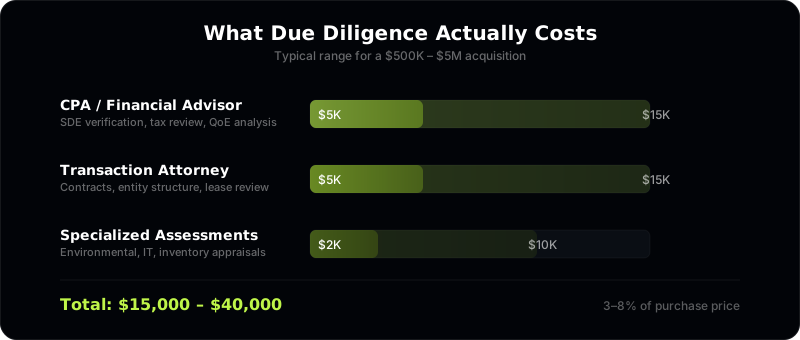
This investment is 3-8% of the purchase price for a typical Main Street deal. Compare that to the cost of discovering a $200,000 problem after closing when you have no leverage to renegotiate.
Frequently Asked Questions
How long should due diligence take when buying a small business?
Plan for 30 to 60 days for businesses under $2M in revenue and 60 to 90 days for larger or more complex businesses. According to IBBA Market Pulse data, the average time to close a business sale is 7 to 10 months from listing — due diligence is a significant portion of that timeline. Do not let a seller pressure you into a compressed schedule. That urgency always benefits them, not you.
What are the most common deal-killers found during due diligence?
The three most frequent deal-killers in small business acquisitions are: (1) financial misrepresentation where SDE is inflated by 20%+ through questionable add-backs, (2) customer concentration where one customer represents more than 25% of revenue, and (3) undisclosed liabilities including tax issues, pending litigation, or environmental problems. Any one of these justifies walking away or renegotiating the price by 20-40%.
Can I do due diligence myself or do I need professionals?
You should lead the process yourself — nobody will protect your capital as carefully as you will. But hire specialists for the technical work: a CPA experienced in business acquisitions for financial verification, a transaction attorney for legal review, and a business appraiser if you are uncertain about how to value the business. Your job is to coordinate these professionals, ask the hard questions, and make the final call.
What is the difference between due diligence for an asset purchase vs. a stock purchase?
In an asset purchase, you buy specific assets and assume only the liabilities you agree to. In a stock purchase, you buy the entire entity including all liabilities — known and unknown. For most small business acquisitions under $5M, an asset purchase is preferred because it limits your liability exposure and provides a step-up in the tax basis of the assets. Your attorney and CPA should advise on which structure makes sense for your specific deal.
How do I pay for due diligence if I am using an SBA loan?
Most buyers fund due diligence costs out of pocket before the SBA 7(a) loan closes. These costs are part of your total investment in the deal and should be factored into your capital requirements from the start. Some SBA lenders will roll reasonable due diligence costs into the loan, but do not count on it. Budget separately.
Putting It All Together
Due diligence is not a checkbox exercise. It is a structured investigation that either builds your confidence in a deal or gives you the evidence to walk away. The 5-Layer DD Stack ensures you evaluate each dimension in the right order — financials first, people last — so you never waste time and money on a deal that should have died at Layer 1.
The checklist above covers more than 50 individual items across financial, legal, operational, customer, and HR categories. Print it out, assign owners to each section, and track completion daily during your due diligence period.
If you are managing multiple acquisition targets simultaneously or want to streamline your due diligence tracking, BuyBox was built for exactly this workflow. It centralizes your deal pipeline, due diligence progress, and financial analysis into a single system designed specifically for small business acquirers.
The 5-Layer DD Stack. 50+ verification items. Zero guesswork. Now go find a deal worth buying.
Brandon Quijano
Acquisition strategist & builder of BuyBox


![How to Write a Letter of Intent to Buy a Business [Template + Guide]](/blog/cover-how-to-write-letter-of-intent-business.svg)