Seller Financing for Business Acquisitions: Negotiation Tactics That Work
How to Get the Seller to Finance Your Deal (Even When They Say No)
Every acquisition entrepreneur eventually runs into the same wall: the bank says yes, but not to the full amount. Or worse, the bank says no entirely. That is where seller financing negotiation tactics become the single most important skill in your deal-making toolkit. The difference between a deal that closes and one that dies on the table usually comes down to whether you can structure a seller note that works for both sides.
According to BizBuySell's annual data, roughly 75% to 90% of small business transactions involve some form of seller financing. This is not a fringe strategy. It is the standard. And yet most first-time buyers walk into the negotiation with no framework, no prepared terms, and no understanding of what motivates the seller to carry a note.
This guide gives you the framework. It covers the exact terms to propose, the psychology behind why sellers agree, how to combine seller financing with SBA lending, and an original decision-making tool I call the Seller Financing Negotiation Matrix.
Every dollar of seller financing is a dollar the seller is betting on your success. Structure the deal so they win when you win, and the negotiation becomes a partnership instead of a fight.
Why Sellers Agree to Finance (When They Do Not Have To)
Before you negotiate terms, you need to understand motivations. Sellers carry notes for five primary reasons, and each one opens a different negotiation angle.
1. Tax deferral through installment sale treatment. When a seller receives the full purchase price at closing, the entire capital gain is taxable in that year. The IRS installment sale rules under Section 453 allow sellers to spread that gain across the life of the note. On a $1M sale with a $600K basis, the difference between a lump sum and a 5-year note can be $50,000 or more in total tax savings. Lead with this number. Most sellers have not done the math.
2. Higher sale price. Sellers who offer financing typically command a 10% to 15% premium on the sale price compared to all-cash deals. This is well-documented across industry broker data. The logic is simple: a larger buyer pool means more competition, and financing expands the pool.
3. Interest income. A $200K seller note at 6% over 5 years generates roughly $32,000 in interest income. For a retiring seller, this is a reliable income stream backed by a business they understand better than any bank does.
4. Deal completion. Many sellers have been on the market for 6 to 12 months. The deal falling apart over a financing gap is their worst nightmare. Carrying a note for $100K to $300K is often preferable to relisting and waiting another year.
5. Confidence signaling. This is the angle most buyers miss. When you ask a seller to finance part of the deal, you are also asking them to put their money where their mouth is. A seller who refuses to carry any note may be signaling that they do not believe the business will perform after the transition. That refusal is due diligence data.
The Seller Financing Negotiation Matrix
Not every deal is the same. A one-size-fits-all approach to seller financing negotiation will leave money on the table in strong deals and waste time on weak ones. The Seller Financing Negotiation Matrix is a 2x2 framework that matches your negotiation strategy to the specific conditions of the deal.
The two axes are:
- Seller Motivation (High or Low): How urgently does the seller need to close? Factors include time on market, health or life events, business performance trajectory, and whether they have already purchased their next venture or retirement property.
- Deal Strength (Strong or Weak): How attractive is the deal from a buyer's perspective? Factors include cash flow consistency, customer diversification, growth trajectory, and clean financials. Run through a full due diligence checklist to assess this honestly.
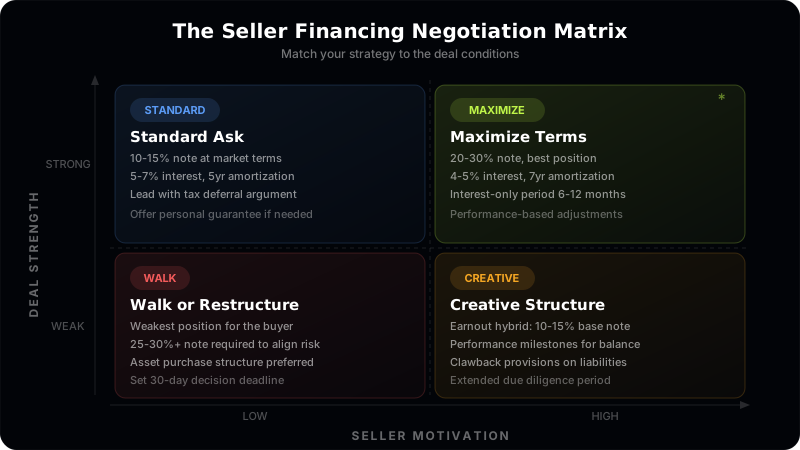
Quadrant 1: High Motivation, Strong Deal — Maximize Terms
This is the best position. The seller wants to close, and the business fundamentals are solid. Your strategy is to push for the most favorable terms possible.
- Request 20% to 30% of the purchase price as a seller note
- Negotiate for below-market interest (4% to 5%)
- Push for a longer amortization (7 years) with no prepayment penalty
- Request a 6-to-12-month interest-only period while you stabilize operations
- Include performance-based adjustments: if trailing twelve-month revenue drops below a threshold within year one, the note balance adjusts downward
This is where you build wealth. Do not leave terms on the table out of politeness.
Quadrant 2: High Motivation, Weak Deal — Creative Structure
The seller needs to close, but the business has issues: customer concentration, declining revenue, deferred maintenance, or operator dependency. Your leverage is high, but your risk is also high.
- Structure the seller note as an earnout hybrid: base note of 10% to 15% of purchase price, with additional payments tied to the business hitting performance milestones
- Negotiate for standby terms on the seller note (more on this below if pairing with SBA)
- Request a longer due diligence period to validate the weaknesses. See our due diligence checklist for the full framework
- Include clawback provisions: if undisclosed liabilities surface within 18 months, they offset against the note balance
- Consider a lower total purchase price with a larger seller note percentage — this reduces your downside if the business underperforms
Quadrant 3: Low Motivation, Strong Deal — Standard Ask
The business is solid and the seller is in no rush. They have leverage and they know it. Your approach is professional and market-rate.
- Propose a seller note of 10% to 15% of the purchase price at market terms (5% to 7% interest, 5-year amortization)
- Lead with the tax deferral argument — this is your strongest card when the seller does not need to close quickly
- Frame the note as a bridge, not a concession: "This is how deals of this size are typically structured"
- Be prepared to offer personal guarantees or additional collateral to reduce seller risk
- Do not overplay your hand. A low-motivation seller with a strong business will simply wait for the next buyer
Quadrant 4: Low Motivation, Weak Deal — Walk or Restructure
This is the weakest position. The seller is not motivated to offer terms, and the business has meaningful risks. In most cases, the right move is to walk.
- If you proceed, the seller note must be large enough (25% to 30%+) to align the seller's incentives with post-close performance
- Require an extended transition period (6 to 12 months) with the seller note payments contingent on successful knowledge transfer
- Explore asset-purchase structure instead of stock purchase to limit liability exposure
- Set a hard deadline for yourself: if terms are not agreed within 30 days, move to the next deal
- Remember, deal flow is a skill, not luck. There are always more deals. Read about how to write a strong letter of intent to keep your pipeline moving
Typical Seller Financing Terms: What the Market Actually Looks Like
Before you draft a proposal, you need to know what is normal. These ranges are drawn from broker industry data, SBA program requirements, and closed transaction databases.
| Term | Typical Range | Notes |
|---|---|---|
| Note size | $100K to $500K | Usually 10% to 30% of total purchase price |
| Interest rate | 5% to 8% | Market rate tracks slightly above prime; below 5% requires strong negotiation position |
| Amortization period | 5 to 7 years | Rarely exceeds 7 years for small business deals |
| Down payment (buyer equity) | 10% to 30% | SBA deals typically require 10% to 15% buyer injection |
| Payment structure | Monthly P&I | Interest-only periods are negotiable, especially in first 6 to 12 months |
| Prepayment penalty | None to 2% | Most seller notes allow prepayment without penalty after year 2 |
| Security | Business assets + personal guarantee | UCC filing on business assets is standard; personal guarantee is negotiable |
| Subordination | Full standby for SBA deals | Required by most SBA lenders; see section below |
These are starting points, not fixed rules. Every term is negotiable.
How to Structure the Seller Financing Ask
The mechanics of making the ask matter as much as the terms themselves. Most negotiations fail not because the terms were wrong, but because the ask was poorly timed or framed.
Step 1: Introduce Seller Financing in the LOI, Not Before
Do not bring up seller financing in your first meeting. First, build rapport and demonstrate that you are a credible buyer. Get through initial due diligence. Then, when you submit your letter of intent, include the seller note as part of the proposed deal structure.
The LOI language should be specific:
"The proposed purchase price of $850,000 shall be funded as follows: $550,000 via SBA 7(a) loan, $150,000 buyer equity injection, and $150,000 seller note at 6% annual interest, amortized over 60 months, with payments beginning 90 days post-closing."
Vague language like "some seller financing to be determined" signals that you have not thought it through.
Step 2: Lead with the Tax Advantage
Open the conversation about seller financing by presenting the tax analysis. Before the meeting, run the numbers using the IRS installment sale rules. Show the seller exactly how much they save in taxes by spreading the gain over 5 to 7 years versus taking a lump sum.
This reframes the conversation. You are not asking the seller for a favor. You are showing them a financial strategy that benefits them.
Step 3: Anchor High on Note Size, Low on Interest
Negotiation 101 applies. Your opening proposal should be at the upper end of what you want:
- If you need a $150K note, ask for $200K
- If you want 5% interest, propose 4%
- If you want 7-year amortization, propose 10 years
The seller (or their broker) will counter. That is the point. Anchoring gives you room to "concede" on terms that were always acceptable to you.
Step 4: Offer Something in Return
Negotiation is not extraction. For every term you request, be prepared to offer something the seller values:
- Higher purchase price in exchange for favorable note terms
- Personal guarantee on the note to reduce seller risk
- Faster closing timeline
- Extended transition consulting agreement (paid) to give the seller ongoing income
- Right of first refusal if you decide to resell within 3 years
Step 5: Get It in Writing Immediately
Once verbal terms are agreed, document them in the asset purchase agreement within 48 hours. Verbal agreements on seller notes fall apart at an alarming rate, usually because the seller's attorney or family members introduce new concerns. Speed to documentation is critical.
Combining Seller Financing with SBA Loans
The most common deal structure in the $500K to $5M range is an SBA 7(a) loan combined with a seller note. The SBA's standard operating procedures allow this, but the seller note must meet specific requirements.
SBA Standby Requirements
When an SBA lender approves a loan that includes a seller note, the SBA requires the seller note to be on full standby for a minimum period — typically 24 months, though some lenders require the standby to match the SBA loan term.
Full standby means:
- No principal or interest payments on the seller note during the standby period
- The seller note is fully subordinated to the SBA loan
- The seller cannot accelerate the note or declare default during standby
- The seller cannot take any collection action that would impair the SBA lender's position
This is a significant ask. You are telling the seller they will receive zero payments on their note for 2 or more years. Here is how to make it palatable:
Increase the interest rate during standby. Offer 7% to 8% during the standby period (with interest accruing but not paid), then step down to 5% to 6% once payments begin. The seller earns a premium for their patience.
Shorten the post-standby amortization. If the total note term is 7 years with a 2-year standby, amortize the payments over the remaining 5 years. The seller gets paid faster once payments start.
Provide regular financial updates. Quarterly P&L statements and annual tax returns during the standby period give the seller visibility into business performance. Transparency reduces anxiety.
For a deeper comparison of these two financing approaches, read our complete breakdown of SBA loans vs. seller financing.
Typical SBA + Seller Note Stack
Here is what a standard deal structure looks like for a $1M acquisition:
| Source | Amount | Percentage | Terms |
|---|---|---|---|
| SBA 7(a) loan | $700K | 70% | 10-year term, prime + 2.75%, monthly P&I |
| Seller note | $200K | 20% | 7-year term, 6%, 24-month full standby |
| Buyer equity injection | $100K | 10% | Cash at closing |
This is a clean, bankable structure. The SBA lender sees 10% buyer skin in the game, 20% seller confidence (they are betting on the business), and 70% senior debt secured by business assets and an SBA guarantee.
For a comprehensive walkthrough of the SBA side of the equation, see our SBA loan guide for business acquisitions.
Earnout Alternatives: When a Straight Note Does Not Work
Sometimes the gap between what the seller wants and what the business can support is too large for a traditional note. That is when earnout structures become relevant.
An earnout ties a portion of the purchase price to post-close business performance. Unlike a seller note, which has fixed payments regardless of performance, an earnout adjusts based on results.
When to Use an Earnout Instead of a Note
- The seller's asking price assumes growth that has not materialized yet
- The business has customer concentration risk (one client is 40%+ of revenue)
- The seller is staying on in an operational role and their contribution directly impacts revenue
- Due diligence revealed discrepancies between claimed and verified performance — see how to value a laundromat for an example of how asset-heavy businesses require different valuation approaches
Earnout Structure Best Practices
Use gross revenue, not net income, as the metric. Net income is too easy to manipulate through expense classification. Gross revenue is clean, auditable, and less subject to accounting judgment.
Set a cap. The total earnout should not exceed 20% to 25% of the purchase price. Beyond that, you are essentially sharing ownership without the seller sharing risk.
Define measurement periods clearly. Quarterly measurements with annual true-ups work well. Monthly is too noisy. Annual is too slow for the seller.
Include acceleration triggers. If the business hits a high-water mark (e.g., 120% of the earnout target), the remaining earnout payments accelerate and pay out immediately. This incentivizes the seller to help you succeed.
Security, Collateral, and Default Provisions
The seller note is a loan. Treat it like one. The promissory note and security agreement need to address three scenarios: normal operations, early payoff, and default.
Collateral Structure
- Business assets (UCC-1 filing): Standard for any seller note. The seller files a UCC-1 lien on business assets. In an SBA combo deal, this lien is subordinate to the SBA lender's first-position lien.
- Personal guarantee: Negotiate hard against this. A limited personal guarantee (capped at 50% of the note balance) is preferable to unlimited personal exposure.
- Real estate (if applicable): If the business includes real property, the seller may request a deed of trust as additional security. This is reasonable only if the real estate is included in the purchase price.
Default Provisions to Negotiate
Default provisions determine what happens when things go wrong. These terms matter more than interest rate or amortization, because they define your worst-case scenario.
Cure period. Insist on a 30-day cure period for any payment default. Most seller note templates use 10 to 15 days, which is insufficient if you are working through a temporary cash flow disruption.
Cross-default provisions. The seller will want the note to be in default if you default on any other business debt (including the SBA loan). Push back on this. A cross-default clause turns a manageable problem with one creditor into a catastrophic problem with all of them.
Acceleration. Standard language allows the seller to accelerate the full note balance upon default. Negotiate a stepped acceleration: first default triggers a late fee, second default within 12 months triggers acceleration. This gives you a one-mistake buffer.
Non-compete interaction. Link the seller's non-compete agreement to the note. If the seller violates the non-compete, the remaining note balance is forgiven. This gives the non-compete real teeth.
Common Mistakes That Kill Seller Financing Negotiations
Bringing it up too early. Mentioning seller financing before you have established credibility as a buyer signals that you cannot afford the deal. Build rapport first, demonstrate financial capability, and introduce the note in the LOI as a structural element, not a plea.
Treating the seller's broker as the enemy. The broker wants the deal to close. Their commission depends on it. A good broker will help sell the seller on carrying a note because it expands the buyer pool and closes deals faster. Frame the conversation as collaborative.
Ignoring the seller's attorney. Many deals fall apart when the seller's attorney reviews the terms and raises objections the seller had not considered. Proactively address common attorney concerns (subordination risk, default exposure, collectibility) in your proposal. Anticipate the pushback before it arrives.
Failing to model the payments. Run the amortization schedule before you propose terms. If the combined SBA payment and seller note payment exceed 1.25x debt service coverage ratio against projected cash flow, the deal is too leveraged. Restructure before proposing, not after.
Forgetting the personal relationship. At the end of the day, a seller is handing their business — often their life's work — to you. Acknowledging that emotional reality and demonstrating genuine respect for what they built is worth more than any financial concession.
Frequently Asked Questions
What is a typical seller financing interest rate?
Seller financing interest rates for small business acquisitions typically range from 5% to 8%, with the most common rate being 6%. The rate should reflect the risk profile of the deal and current market conditions. A seller note that is subordinated to an SBA loan (full standby) often commands a slightly higher rate (7% to 8%) because the seller's risk is elevated during the standby period. Rates below 5% are achievable in high-motivation scenarios but are uncommon.
Can you combine SBA and seller financing?
Yes. Combining an SBA 7(a) loan with a seller note is the most common acquisition financing structure in the $500K to $5M range. The SBA allows seller notes as part of the capital stack, but the note must be on full standby — meaning no principal or interest payments — for a minimum period, typically 24 months. The seller note must also be fully subordinated to the SBA loan. This structure benefits buyers by reducing the equity injection required (often to just 10% of the purchase price) while giving sellers favorable installment sale tax treatment.
What happens if the buyer defaults on a seller note?
Default consequences depend entirely on the terms in the promissory note and security agreement. In a typical seller-financed deal, the seller has a UCC-1 lien on business assets and can pursue collection through the courts. If the note includes acceleration provisions, the full remaining balance becomes due immediately upon default. If a personal guarantee was signed, the seller can pursue the buyer's personal assets. In SBA combo deals, the SBA lender's first-position lien takes priority, meaning the seller may recover little or nothing from business assets if both the SBA loan and seller note are in default simultaneously. This is why cure periods and stepped default provisions are critical to negotiate.
How much seller financing should a buyer ask for?
The standard range is 10% to 30% of the total purchase price, with 15% to 20% being the most common. The right amount depends on your deal structure. In an SBA combo deal, the seller note typically covers 15% to 20%, with the SBA loan at 70% to 75% and buyer equity at 10% to 15%. In a non-SBA deal, seller notes can represent a larger percentage — sometimes 40% to 50% — but this increases seller risk and typically results in higher interest rates or shorter amortization periods.
Is seller financing taxed as ordinary income or capital gains?
Under IRS installment sale rules (Publication 537), the principal portion of each payment is taxed at capital gains rates, while the interest portion is taxed as ordinary income. This is one of the primary reasons sellers agree to carry notes. By spreading the capital gain over the life of the note, the seller may stay in a lower tax bracket each year compared to recognizing the entire gain at closing. The tax advantage is particularly meaningful for sellers whose business has appreciated significantly above their cost basis.
Putting It All Together
Seller financing negotiation is not about winning. It is about structuring a deal where both parties have aligned incentives for the business to succeed after closing. The Seller Financing Negotiation Matrix gives you a framework for adapting your approach to the specific conditions of each deal. The tactical playbook in this guide gives you the exact terms, language, and sequencing to execute.
The best deals are the ones where the seller stays invested — literally — in your success. A well-structured seller note accomplishes that. The seller earns interest income, defers taxes, and has a financial incentive to support a smooth transition. You get the capital structure you need to close the deal without over-leveraging day one.
If you are actively evaluating deals and want a system that tracks every term, models the financing stack, and flags negotiation opportunities automatically, take a look at BuyBox. It is the acquisition management platform built for exactly this kind of work.
This article is for educational purposes only and does not constitute legal or financial advice. Consult qualified professionals for your specific transaction.
Brandon Quijano
Acquisition strategist & builder of BuyBox

![How to Write a Letter of Intent to Buy a Business [Template + Guide]](/blog/cover-how-to-write-letter-of-intent-business.svg)