How to Write a Letter of Intent to Buy a Business [Template + Guide]
The Letter of Intent That Gets Sellers to Say Yes (Not Throw It Away)
If you are learning how to write a letter of intent to buy a business, you need to understand something most guides will not tell you: the LOI is not paperwork. It is a sales document. It is the moment where a seller decides whether you are a serious buyer worth spending the next 90 days with — or another tire-kicker wasting their time.
I have seen seven-figure deals collapse because of sloppy LOIs. I have also seen buyers win competitive bids — not by offering the highest price, but by submitting the most complete, professional, and well-structured letter of intent. The difference between the two comes down to eight sections, and most buyers get at least three of them wrong.
An LOI is where deals are won or lost. The purchase agreement just memorializes the outcome.
This guide walks through every section of a business acquisition LOI, introduces the LOI Strength Checklist framework for scoring your letter before you submit it, and covers the binding vs. non-binding distinction that trips up first-time buyers.
What Is a Letter of Intent (And What It Is Not)
A letter of intent — also called an LOI or term sheet — is a written document that outlines the proposed terms of a business acquisition before the buyer and seller enter into a definitive purchase agreement. According to the Corporate Finance Institute, the LOI establishes the framework for negotiation and signals mutual interest in moving forward.
Here is what an LOI is:
- A summary of the key deal terms both parties intend to negotiate toward
- A demonstration of seriousness and financial capability
- A roadmap for the due diligence and closing process
- A vehicle for securing exclusivity so you can diligence without competition
Here is what an LOI is not:
- A binding purchase agreement (with specific exceptions — see below)
- A guarantee that the deal will close
- A substitute for legal counsel
- A place to leave sections vague because "we will figure it out later"
That last point matters more than most buyers realize. Every ambiguous clause in an LOI creates a negotiation battle during the purchase agreement phase. Sellers and their attorneys exploit vagueness. Your job is to eliminate it.
Binding vs. Non-Binding: The Distinction That Matters
Most LOIs are structured as non-binding documents, meaning neither party is legally obligated to complete the transaction based on the LOI alone. However — and this is critical — certain provisions within a non-binding LOI are typically made binding. The SBA's guide to buying a business emphasizes understanding which terms create legal obligations before you sign.
Typically binding provisions:
- Exclusivity (no-shop) clause — The seller agrees not to solicit or entertain other offers during a defined period
- Confidentiality obligations — Both parties agree to keep deal terms and diligence findings private
- Expense allocation — Who pays for what during due diligence (legal, accounting, environmental assessments)
- Governing law — Which state's laws govern the LOI and any disputes
Typically non-binding provisions:
- Purchase price and structure
- Payment terms
- Due diligence scope and timeline
- Closing conditions
- Representations and warranties
The reason this matters: if you sign an LOI with a binding exclusivity clause and then walk away from the deal without cause, you could face legal consequences. Conversely, if the seller signs a binding exclusivity clause and shops the deal to other buyers during your diligence period, you have legal recourse.
Always have an attorney review your LOI before submission. The line between binding and non-binding is jurisdiction-specific and easy to get wrong.
The LOI Strength Checklist: 8 Sections Every LOI Must Have
Most LOI templates give you a fill-in-the-blank document. The problem is that templates do not tell you whether your terms are strong, weak, or deal-killing. That is why I developed the LOI Strength Checklist — a framework that scores each of the eight essential LOI sections so you can identify weaknesses before the seller does.
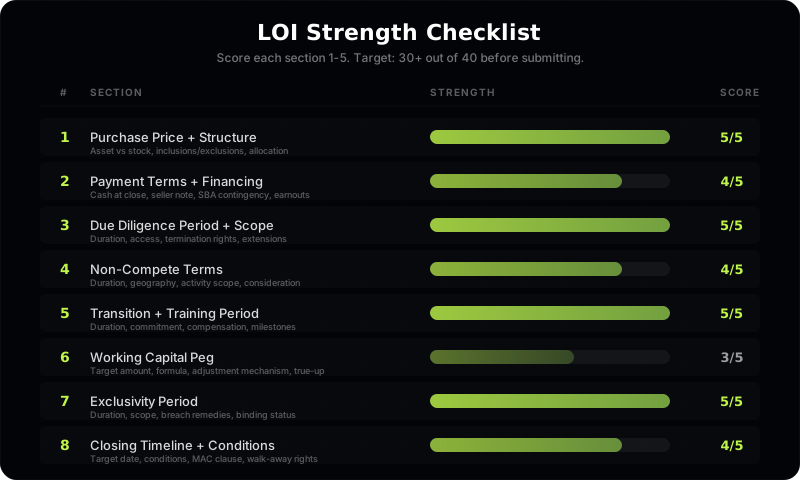
Here is how it works: each section gets a strength rating from 1 to 5. A score of 3 or below in any section means you need to revise before submitting. A total score below 30 out of 40 means your LOI is not competitive. A score above 35 means you are putting your best foot forward.
Let us walk through each section.
Section 1: Purchase Price and Structure (Asset vs. Stock)
This is the first thing a seller reads. Not your cover letter, not your background — the number. Make it clear, make it justified, and make the structure explicit.
What to include:
- Total purchase price (a specific number or a narrow range with a clear formula)
- Whether this is an asset purchase or a stock/equity purchase
- What is included: inventory, equipment, intellectual property, customer lists, goodwill
- What is excluded: cash on hand, personal assets of the seller, pre-closing receivables
Asset vs. stock has significant tax implications for both parties. The IRS publication on sale of a business details how asset purchases allow the buyer to step up the basis of acquired assets, creating tax depreciation benefits. Sellers generally prefer stock sales for capital gains treatment. This is a negotiation point — know where you stand before you submit.
Strength scoring:
- 5/5: Specific price, clear structure, detailed inclusion/exclusion list, allocation methodology referenced
- 3/5: Price stated but structure vague, no asset allocation discussion
- 1/5: Price range with no formula, structure not mentioned
Example language: "Buyer proposes to acquire substantially all of the assets of the Business for a total purchase price of $1,250,000, allocated among tangible assets, intangible assets, and goodwill in accordance with Section 1060 of the Internal Revenue Code. This is structured as an asset purchase. Excluded from the transaction are cash and cash equivalents, pre-closing accounts receivable, and the Seller's personal vehicle currently titled to the business."
Section 2: Payment Terms and Financing Contingency
The purchase price tells the seller what you are willing to pay. The payment terms tell them when and how you will actually pay it. Sellers care about certainty of close. A $1.5M all-cash offer from a buyer with unverified financing loses to a $1.3M offer from a buyer with an SBA pre-qualification letter every time.
For a deeper understanding of SBA financing in acquisitions, see our guide on SBA loans for business acquisitions.
What to include:
- Cash at closing (amount and source — personal funds, investor equity, or loan proceeds)
- Seller financing terms: amount, interest rate, term length, collateral, and subordination
- SBA or conventional loan contingency: pre-qualification status, lender name if possible
- Earnout provisions: triggers, measurement periods, caps, and dispute resolution
- Deposit or escrow amount upon LOI execution
Strength scoring:
- 5/5: Detailed payment waterfall, proof of funds or pre-qualification attached, seller note terms fully specified
- 3/5: Payment split mentioned but no proof of funds, seller note terms vague
- 1/5: "Subject to financing" with no details on source or status
Sellers evaluate payment terms for one thing above all else: likelihood of close. If your LOI says "subject to obtaining financing" without specifying that you are pre-qualified with a named lender, the seller reads that as "this buyer has no money and no plan to get it."
If you plan to use seller financing as part of the deal structure, spell out the terms completely. A seller note of $300,000 at 6% over 5 years with a personal guarantee and subordinated to the senior lender is a clear term. "Some portion of seller financing TBD" is not.
Section 3: Due Diligence Period and Scope
The due diligence section defines how much time you have to investigate the business and what access the seller must provide. Too short and you cannot complete diligence. Too long and the seller gets nervous.
For a comprehensive framework on what to investigate during this period, see the business acquisition due diligence checklist.
What to include:
- Duration: typically 45 to 90 days from LOI execution, with an extension option
- Scope: financial records, legal documents, operational data, employee information, customer data, vendor contracts, real property
- Access requirements: on-site visits, employee interviews (timing and confidentiality), system access
- Termination rights: buyer's right to terminate for any reason during diligence (this should be absolute)
- Confidentiality during diligence: who can know, what can be shared with your advisors
Strength scoring:
- 5/5: Specific duration with extension option, detailed scope list, clear access requirements, absolute termination rights
- 3/5: Duration stated but scope vague, no extension option
- 1/5: "Customary due diligence" with no specifics
Industry benchmarks: According to BizBuySell market data, the median due diligence period for small business acquisitions in the $500K to $5M range runs 60 to 75 days. For deals with SBA financing, budget 75 to 90 days because the lender has its own diligence requirements that run in parallel.
Do not accept a diligence period shorter than 45 days unless you have already completed preliminary due diligence before submitting the LOI. And always include a 15 to 30-day extension option — you will need it when the seller takes two weeks to produce the documents you requested on day one.
Section 4: Non-Compete Terms
A business is only worth what it earns after you buy it. If the seller can open a competing operation across the street six months after closing, you have not bought a business — you have bought a customer list with an expiration date.
What to include:
- Duration: typically 3 to 5 years (courts vary by state on enforceability — consult your state's specific non-compete statute)
- Geographic scope: should match the business's actual service area, not an unreasonably broad territory
- Activity scope: what specific competitive activities are prohibited
- Exceptions: consulting for the buyer, passive investments, unrelated businesses
- Consideration: the non-compete must be supported by consideration (often a portion of the purchase price is allocated to it)
Strength scoring:
- 5/5: Specific duration and geography, activity scope defined, reasonable and enforceable, consideration allocated
- 3/5: Duration mentioned but geography or activity scope vague
- 1/5: Not mentioned or "customary non-compete"
A non-compete that is too broad will not hold up in court. A non-compete that is too narrow will not protect your investment. The sweet spot for most small business acquisitions is 3 to 5 years within the metropolitan statistical area where the business operates, covering the specific industry and customer segment.
Section 5: Transition and Training Period
This is the section most first-time buyers underestimate, and it is often where acquisitions fail in the first 90 days. The seller has relationships, institutional knowledge, and operational habits that are not written down anywhere. If they walk out the door on closing day, you are flying blind.
What to include:
- Duration: typically 30 to 180 days post-closing, with clear milestones
- Seller's time commitment: full-time, part-time, or as-needed (specify hours per week)
- Compensation: salary, hourly rate, or included in purchase price
- Scope: what the seller will do during transition (customer introductions, vendor relationship transfers, employee training, operational procedures documentation)
- Availability after transition: phone/email access for a defined period
Strength scoring:
- 5/5: Specific duration with milestones, time commitment defined, compensation clear, detailed scope, post-transition availability
- 3/5: "Seller will assist with transition for a reasonable period"
- 1/5: Not mentioned
What sellers expect: Most sellers of businesses in the $1M to $5M range expect to provide 60 to 90 days of transition support. Anything less than 30 days raises concerns that you do not understand the business. Anything more than 180 days suggests the business cannot operate without the seller, which should concern you as a buyer.
Section 6: Working Capital Peg
Working capital is the silent deal-killer. If you do not address it in the LOI, you will fight about it for weeks during the purchase agreement negotiation. The working capital peg establishes the minimum amount of current assets minus current liabilities the seller must deliver at closing.
What to include:
- Target working capital amount (usually the trailing 12-month average of net working capital)
- Definition of which accounts are included and excluded
- Measurement methodology: who calculates it, when, and using what accounting standards
- Adjustment mechanism: dollar-for-dollar adjustment to the purchase price for any shortfall or surplus
- True-up period: typically 60 to 90 days post-closing for final reconciliation
Strength scoring:
- 5/5: Specific target amount with formula, defined accounts, adjustment mechanism, true-up period
- 3/5: "Customary working capital" or target without adjustment mechanism
- 1/5: Not mentioned
Why this matters: I have seen sellers drain working capital between LOI signing and closing — collecting receivables, delaying payables, drawing down inventory. Without a peg, you close the deal and discover that the business needs an immediate capital injection of $100,000 to $200,000 just to operate normally. The peg protects you.
The most common formula: average monthly net working capital over the trailing 12 months, calculated as current assets (cash, receivables, inventory, prepaid expenses) minus current liabilities (accounts payable, accrued expenses, current portion of long-term debt). Exclude cash if it is not part of the acquisition.
Section 7: Exclusivity Period
Exclusivity — also called a no-shop provision — prevents the seller from soliciting, entertaining, or negotiating with other potential buyers during a defined period. Without it, you are investing time and money in due diligence while the seller uses your offer as leverage to drive up the price with other buyers.
What to include:
- Duration: typically 60 to 90 days, coterminous with or slightly longer than the due diligence period
- Scope: no solicitation, no negotiation, no provision of information to other buyers
- Carve-outs: whether the seller must notify you of unsolicited offers
- Remedies: what happens if the seller breaches (break-up fee, expense reimbursement, specific performance)
- This provision should be binding
Strength scoring:
- 5/5: 60-90 day binding exclusivity, no-solicitation and no-negotiation scope, breach remedies defined, unsolicited offer notification required
- 3/5: Exclusivity mentioned but duration or scope vague, no breach remedies
- 1/5: Not mentioned or "seller will use best efforts to not shop the deal"
How to handle competing offers: If a broker tells you there are multiple interested parties, your LOI needs to stand on its own merit. Competing by raising your price is a losing strategy — you end up overpaying for a business you have not yet diligenced. Instead, compete on certainty of close: attach proof of funds, name your lender, provide a clear timeline, and reference your industry experience. Sellers choose the buyer most likely to close, not necessarily the buyer offering the most money.
Industry benchmarks: Most acquisition intermediaries recommend 60 to 90 days of exclusivity for deals under $5M. Shorter than 60 days creates pressure that leads to sloppy diligence. Longer than 90 days raises concerns for the seller that you are not serious or capable.
Section 8: Closing Timeline and Conditions
The closing section maps out the path from signed LOI to closing day. It tells the seller when they get paid and what has to happen between now and then. Be specific — vagueness here makes sellers anxious.
What to include:
- Target closing date: typically 75 to 120 days from LOI execution
- Conditions to closing: satisfactory completion of due diligence, financing approval, landlord consent to lease assignment, third-party consents, regulatory approvals
- Material adverse change clause: the deal terminates if something fundamentally changes (key customer loss, regulatory action, material litigation)
- Walk-away provisions: under what circumstances can each party terminate without penalty
- Deposit: refundable during diligence, partially or fully non-refundable after diligence completion
Strength scoring:
- 5/5: Specific target date, conditions enumerated, MAC clause, clear walk-away rights, deposit terms
- 3/5: Target date with "customary closing conditions"
- 1/5: "Closing will occur at a mutually agreeable time"
A well-structured closing section gives the seller confidence that you have a plan and the capability to execute it. It also protects you by enumerating the conditions that must be satisfied before you are obligated to close.
Scoring Your LOI: How to Use the Strength Checklist
Before you submit your LOI, score each section on the 1-to-5 scale. Here is how to interpret your total:
| Total Score | Interpretation |
|---|---|
| 36-40 | Institutional quality. You are competing with private equity. |
| 30-35 | Strong. This LOI will be taken seriously by any seller. |
| 24-29 | Adequate but vulnerable. Strengthen weak sections before submitting. |
| Below 24 | Do not submit. Revise until you score above 30. |
The most common weak sections for first-time buyers are Section 2 (payment terms — because they have not secured financing yet), Section 6 (working capital — because they do not know what it is), and Section 7 (exclusivity — because they do not realize they need it).
Common Mistakes That Kill LOIs
After reviewing hundreds of LOIs across deals ranging from $250K to $15M, these are the patterns that consistently kill deals or weaken the buyer's position:
Mistake 1: Submitting a one-page LOI. A one-page LOI signals that you are either unsophisticated or not serious. Sellers of profitable businesses receive multiple offers. Your LOI competes with buyers who have attorneys drafting comprehensive term sheets. If yours looks like it was written on a napkin, it goes to the bottom of the pile.
Mistake 2: Leaving the deal structure ambiguous. "We will discuss the structure during due diligence" is not a structure. The seller needs to understand the tax implications of your proposed structure before they commit to exclusivity. Asset purchase or stock purchase — pick one and state it clearly.
Mistake 3: Excessive contingencies without specificity. Every contingency you add reduces the seller's perceived certainty of close. That does not mean you eliminate contingencies — it means you make them specific. "Subject to buyer obtaining financing" is weak. "Subject to buyer obtaining SBA 7(a) financing through Live Oak Bank, with whom buyer has been pre-qualified for loans up to $2,000,000" is strong.
Mistake 4: No proof of financial capability. Attach a proof-of-funds letter, bank statement (redacted), or lender pre-qualification letter. Sellers will not take you seriously without evidence that you can actually pay what you are proposing.
Mistake 5: Ignoring the working capital peg. This is the mistake that costs buyers the most money post-closing. If you do not establish a working capital target in the LOI, the seller has every incentive to strip the business of cash, accelerate receivable collections, and delay payable payments before closing. You close the deal and immediately need to inject capital.
Mistake 6: Omitting the non-compete. If the seller built the business and knows every customer by name, a non-compete is not optional. Leaving it out of the LOI does not mean you can add it later — it means the seller's attorney will fight you on it during the purchase agreement negotiation, and your leverage will be lower because you have already committed to the deal terms.
What Sellers Actually Look For in an LOI
I have spoken with dozens of business sellers and brokers. Here is what moves an LOI from the "maybe" pile to the "let us talk" pile:
- Certainty of close. Can this buyer actually get the deal done? Proof of funds, named lender, clear timeline.
- Respect for the business they built. A generic LOI that could apply to any business signals that you have not done your homework. Reference specific aspects of the business.
- Fair price with clear rationale. Sellers know what their business is worth. If your offer is below asking, explain why with data — not "we think it is worth less." Reference multiples, comps, or industry-specific valuation benchmarks.
- Clean deal structure. Few contingencies, specific terms, professional presentation. The LOI should read like it was prepared by someone who has done this before.
- Reasonable timeline. 75 to 90 days to close from LOI is standard. If you need 180 days, the seller wonders why.
After the LOI Is Signed: What Happens Next
Once both parties sign the LOI, the clock starts on your exclusivity and due diligence periods. Here is the typical sequence:
Week 1-2: Request and receive initial document package (financials, contracts, legal documents). Begin financial and legal review with your CPA and attorney.
Week 3-4: On-site visit and operational observation. Meet key employees (if appropriate at this stage). Begin customer and vendor reference checks.
Week 5-6: Complete financial reconstruction and identify any discrepancies. Flag issues for re-negotiation or additional information requests.
Week 7-8: Draft purchase agreement. Negotiate final terms based on diligence findings. For a deeper look at what can go wrong, see our anatomy of a failed deal.
Week 9-10: Finalize financing, obtain third-party consents (landlord, key vendors, licensors). Complete legal review.
Week 11-12: Final walk-through, closing document execution, fund transfer, key handoff.
This timeline assumes a clean deal. Add 2 to 4 weeks for SBA-financed acquisitions because the lender has its own diligence process that runs in parallel.
Frequently Asked Questions
Is a letter of intent legally binding?
Most LOIs are structured as non-binding documents, meaning neither party is legally obligated to complete the transaction. However, specific provisions within the LOI are typically made binding — most commonly exclusivity (no-shop), confidentiality, expense allocation, and governing law. Always have an attorney review the LOI to confirm which provisions create legal obligations in your jurisdiction. Courts have occasionally found entire LOIs to be binding when the language was ambiguous, so clarity matters.
How long should an LOI exclusivity period be?
The standard exclusivity period for small business acquisitions ranges from 60 to 90 days. Sixty days is tight but workable for deals under $1M with straightforward operations. Seventy-five to 90 days is appropriate for deals between $1M and $5M or businesses with complex operations, multiple locations, or regulatory requirements. Always include a 15 to 30-day extension option in case diligence uncovers issues that require additional investigation.
Can I submit multiple LOIs at once?
There is no legal prohibition against submitting LOIs to multiple sellers simultaneously, but there are practical risks. If you sign exclusivity with one seller and then divert your attention to another deal, you risk burning through your exclusivity period without completing diligence — and damaging your reputation with the broker community. If you are evaluating multiple businesses, submit your strongest LOI first and keep others in the pipeline. The small business acquisition market is relationship-driven, and brokers talk to each other.
What happens after the seller signs the LOI?
Once both parties execute the LOI, three things happen simultaneously: your exclusivity period begins (the seller stops entertaining other offers), your due diligence period starts (you begin investigating the business), and your attorney begins drafting the definitive purchase agreement based on the LOI terms. The LOI serves as the instruction set for the purchase agreement — the more detailed your LOI, the fewer issues arise during the PA negotiation.
How do I handle a seller who refuses exclusivity?
A seller who refuses exclusivity is telling you one of two things: they have another serious buyer they do not want to lose, or they do not take your offer seriously enough to commit. In either case, you have leverage issues. You can propose a shorter exclusivity period (45 days), offer a non-refundable deposit as consideration for exclusivity, or walk away. Conducting due diligence without exclusivity is risky — you invest $15,000 to $30,000 in professional fees while the seller shops your offer to other buyers. In most cases, no exclusivity means no deal.
Putting It All Together
Writing a strong letter of intent is not about legal perfection — it is about strategic communication. You are telling the seller: I am serious, I am capable, I understand your business, and I have a clear plan to close this deal.
Use the LOI Strength Checklist to score your letter before you submit it. If any section scores below 3, revise it. If your total score is below 30, you are not ready. A strong LOI does not guarantee you will close the deal, but a weak one almost guarantees you will not.
The buyers who consistently win deals are not the ones offering the highest price. They are the ones submitting the most professional, complete, and well-thought-out LOIs. In a market where BizBuySell reports that only 20% of listed businesses actually sell, being the buyer who inspires confidence is the single greatest advantage you can have.
If you are managing multiple deals or want to track your LOI scoring across opportunities, BuyBox was built to systematize exactly this kind of deal pipeline management — from initial screening through LOI submission to due diligence tracking and close.
This guide reflects general business acquisition practices. LOI requirements vary by jurisdiction, deal size, and industry. Always consult with a qualified attorney and CPA before submitting a letter of intent.
Brandon Quijano
Acquisition strategist & builder of BuyBox