Deal Autopsy: Why This $1.2M Acquisition Failed
I Watched a $1.2 Million Deal Collapse. Here Is Exactly What Went Wrong.
One of the biggest mistakes buying a small business is assuming that a good-looking deal on paper will be a good deal in practice. I have seen this play out dozens of times across different industries and price points, but one deal in particular stands out as a textbook example of how multiple small oversights compound into a catastrophic failure. This is the story of a $1.2M HVAC business acquisition that looked like a home run — right up until the moment it fell apart.
What follows is a composite case study drawn from real deal patterns I have encountered. The names, locations, and certain details have been changed, but the dynamics, the numbers, and the mistakes are all grounded in reality. I am sharing this because the acquisition community talks endlessly about wins. Nobody wants to dissect the losses. But the losses are where the real education lives.
You will learn more from one failed deal you study carefully than from ten successful deals you celebrate blindly.
The Deal That Looked Too Good to Pass Up
The buyer — we will call him Mike — was a 38-year-old operations manager at a mid-size facilities company. He had spent 12 years managing teams, reading P&Ls, and dreaming about owning his own business. He had $180,000 in savings, a solid credit score, and a wife who was cautiously supportive. He was exactly the profile that SBA 7(a) lenders love to approve.
The business was Comfort Air Services (not its real name), an HVAC installation and repair company operating in a mid-size Southeastern city. It had been in business for 19 years under the same owner, a 61-year-old named Dave who wanted to retire.
Here is what the deal looked like on the listing sheet:
| Metric | Value |
|---|---|
| Asking Price | $1,200,000 |
| Annual Revenue | $1,850,000 (3-year average) |
| Seller Discretionary Earnings | $375,000 |
| SDE Multiple | 3.2x |
| Employees | 6 full-time (including owner) |
| Service Vehicles | 2 fully equipped trucks |
| Years in Business | 19 |
| Financing | SBA 7(a) pre-qualified |
On the surface, this looked like a strong acquisition. The BizBuySell Insight Report shows that service businesses in this revenue range typically trade between 2.5x and 3.5x SDE, putting the 3.2x multiple squarely within market norms. The business had nearly two decades of operating history. Revenue had been stable. The SDE was strong enough to comfortably service the debt under SBA terms.
Mike submitted an LOI within three weeks of first seeing the listing.
What Looked Good on Paper
During initial conversations with the broker, Mike learned several things that reinforced his enthusiasm.
Consistent revenue. Comfort Air had generated between $1.7M and $2.0M in revenue each of the prior three years. No dramatic swings. The business appeared to have a stable customer base that generated predictable demand across residential and commercial segments.
Established reputation. Nineteen years in the same market with a 4.6-star Google rating and over 200 reviews. The kind of local reputation that takes years to build and is genuinely difficult to replicate. According to Harvard Business Review research on M&A success factors, brand equity and customer loyalty are among the most undervalued intangible assets in small business acquisitions.
Tangible assets. Two fully equipped service trucks, a parts inventory valued at $45,000, and a workshop lease with four years remaining at below-market rent. These assets gave the deal a floor value that made the downside feel limited.
SBA pre-qualification. The deal had already been pre-qualified for SBA 7(a) financing with a 10% down payment. Mike would need to inject roughly $120,000 of his own capital, leaving him with a $60,000 cash reserve.
Owner willingness to transition. Dave said he would stay on for 90 days post-close to help with the transition. This is a standard arrangement and one that Mike viewed as a safety net.
Everything pointed toward a clean acquisition with manageable risk. Mike hired a broker-recommended CPA to review the financials and engaged a local attorney for legal diligence. He was moving fast — and that speed would cost him.
The Five Red Flags Mike Missed
This is where the story turns. Each of these red flags was individually survivable. Together, they were fatal.
Red Flag 1: The Owner Was the Lead Technician
Dave was not just the owner of Comfort Air. He was the company's best HVAC technician — and its only certified installer for commercial systems. Of the company's $1.85M in revenue, roughly $620,000 came from commercial installation projects that required Dave's personal involvement. He held the contractor's license. He managed the commercial relationships. He did the site assessments.
This is what I call operator dependency — and it is one of the most common and most dangerous patterns in small business acquisitions. When you buy a business where the owner is the primary revenue driver, you are not buying a business. You are buying a job, and you are overpaying for it.
Mike asked about this during diligence. Dave assured him that his lead technician, a 15-year employee named Carlos, could handle the commercial work. Mike took Dave's word for it. He did not interview Carlos independently. He did not verify Carlos's certifications. He did not ask Carlos whether he intended to stay after the acquisition.
For a structured approach to catching operator dependency, see our business acquisition due diligence checklist.
Red Flag 2: Revenue Concentration in Three Commercial Contracts
A closer look at the revenue breakdown revealed something the listing sheet did not highlight: 40% of Comfort Air's revenue — roughly $740,000 annually — came from just three commercial maintenance contracts. These were large property management companies that had multi-year service agreements with Comfort Air.
Here is the problem: two of those three contracts were up for renewal within eight months of the expected closing date. The third had an assignability clause that required the client's written consent for any change of ownership.
Revenue concentration above 25% in any single client is a red flag. Revenue concentration of 40% across three clients, with renewal uncertainty and assignability restrictions, is a deal-breaker that should have triggered an immediate price renegotiation — or a walk-away.
The International Business Brokers Association (IBBA) survey data consistently shows that customer concentration is among the top three reasons small business acquisitions underperform post-close. Mike's CPA flagged the concentration in a footnote. Mike read the footnote and moved on.
Red Flag 3: Equipment Was Older Than Represented
The listing described the service trucks as "well-maintained" and the shop equipment as "recently updated." During his site visit, Mike noticed that the trucks looked clean and professional. What he did not do was check the odometers, review the maintenance logs, or get an independent equipment appraisal.
Post-close, Mike discovered that both trucks had over 180,000 miles each. The compressors and diagnostic equipment in the shop were 8-12 years old — not the 3-5 years he had assumed from the listing language. The estimated replacement cost for the two trucks and critical shop equipment was $165,000, a capital expenditure that was not anywhere in his financial model.
This is a common pattern in service businesses: sellers suppress capital expenditures in the two to three years before a sale to inflate SDE. The equipment works today, but the deferred maintenance creates a ticking clock that the buyer inherits. For more on how to properly assess asset conditions during valuation, see our guide on how to value a laundromat — the asset assessment principles apply across industries.
Red Flag 4: The Key Employee Was Planning to Leave
Remember Carlos, the lead technician Dave said would handle the commercial work post-transition? Six weeks after closing, Carlos gave his two-week notice. He had been planning to leave for months — Dave knew, and he did not disclose it.
Carlos had been offered a position at a competitor with a $15,000 salary increase and a path to partnership. He had no non-compete agreement (Dave had never required one). And because Carlos held relationships with several of the commercial clients, his departure threatened not just operational capacity but client retention.
According to IBBA transaction data, key employee retention is the second most cited post-acquisition challenge after revenue decline. Mike's purchase agreement included a standard seller representation that "no key employees have indicated intent to resign." Dave either lied or defined "indicated" very narrowly. Either way, the legal cost of pursuing that claim would have exceeded the recovery.
If you are navigating a transition and want to avoid this trap, our guide on the first 90 days after buying a business covers key employee retention strategies in depth.
Red Flag 5: The Transition Was Not Really a Transition
Dave's 90-day transition period was supposed to be a structured handoff. In practice, Dave showed up sporadically, spent most of his time on personal errands, and grew increasingly disengaged. He had mentally checked out the moment the wire hit his account.
Mike had no written transition plan with deliverables, milestones, or accountability mechanisms. The purchase agreement referenced a "transition period" but did not define what that meant in operational terms. Dave's presence became a liability — he was confusing employees by contradicting Mike's early decisions while contributing almost nothing to knowledge transfer.
The Timeline: From LOI to Collapse
Here is how the deal unfolded, week by week:
Week 0-3: Mike finds the listing, visits the business twice, meets Dave and the team. Everything feels right. Submits LOI at $1.2M.
Week 4-8: Due diligence begins. CPA reviews three years of tax returns and P&Ls. Revenue checks out. SDE reconstruction comes within 5% of Dave's number. Attorney reviews the lease and major contracts. The revenue concentration is noted but not escalated.
Week 9-12: SBA loan approved. Mike negotiates minor price adjustments ($30K reduction for some inventory discrepancies). Nobody does an independent equipment appraisal. Nobody interviews employees separately from the owner.
Week 13: Closing. Mike wires $120,000 of his own money. SBA funds $1,050,000. Deal closes.
Week 14-18: Dave's transition begins. It becomes clear within two weeks that Dave is disengaged. Mike is running the business and learning the operations simultaneously. He discovers the truck mileage issue.
Week 19: Carlos gives notice. Mike panics and offers a $20,000 retention bonus. Carlos declines.
Week 22-26: First commercial contract renewal comes up. Without Carlos and without Dave's relationships, the property management company declines to renew. That is $280,000 in annual revenue gone.
Week 30: Second commercial contract expires. The client agrees to a short-term extension at a 30% rate reduction while they "evaluate alternatives." Mike knows they are shopping for a replacement.
Week 36-44: Revenue has dropped 35% from the trailing twelve months used in valuation. Mike is now personally doing commercial service calls — work he is not certified to perform. He hires two new technicians at market rate, increasing payroll by $140,000 annually.
Month 12: The business generates $1.1M in revenue (down from $1.85M) and an SDE of approximately $95,000 — barely enough to service the SBA debt. Mike has burned through his $60,000 cash reserve and taken on a $40,000 line of credit. His wife is no longer cautiously supportive.
Month 18: Mike begins exploring a sale. The business is now worth roughly $350,000-$450,000 on the open market — less than half of what he paid. He is underwater on the SBA loan. The bank begins discussions about restructuring.
The Deal Autopsy Framework
Every failed acquisition contains lessons — but only if you have a structured way to extract them. I developed the Deal Autopsy Framework after studying dozens of deals that went sideways. It consists of five post-mortem questions that force you to identify exactly where the process broke down and how to prevent the same failure in the future.
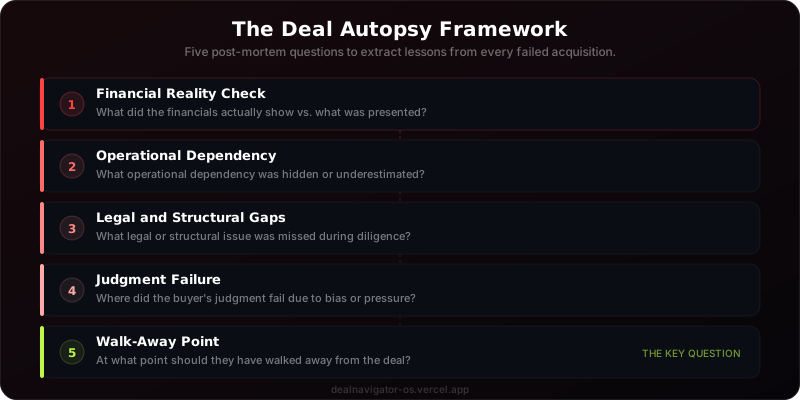
Question 1: What Did the Financials Actually Show vs. What Was Presented?
In Mike's case, the financial presentation was not fraudulent — it was selectively honest. The SDE reconstruction checked out because the add-backs were legitimate. Revenue was accurately reported. But the financials told an incomplete story.
What was missing: the deferred capital expenditure analysis. Dave had spent virtually nothing on equipment in the two years before the sale. A proper financial diligence would have included a CapEx normalization — adding back the maintenance and replacement spending that should have occurred but did not. This alone would have reduced the adjusted SDE by $45,000-$60,000, dropping the effective multiple from 3.2x to over 4x at the same purchase price.
The lesson: Financial diligence is not just about verifying what is in the P&L. It is about identifying what should be in the P&L but is not.
Question 2: What Operational Dependency Was Hidden?
Dave's role as the lead commercial technician was not hidden — it was visible to anyone who looked. The problem is that Mike did not look hard enough. He accepted the seller's assurance that the business could operate without him instead of independently verifying that claim.
The operational dependency test is simple: for each revenue stream, ask "who performs this work?" and "what happens if that person is unavailable for 90 days?" If the answer to the second question is "revenue stops," you have a dependency that must be priced into the deal or mitigated before closing.
The lesson: Talk to employees without the owner in the room. Ask them directly what they do, what the owner does, and what they think would happen if the owner left. Their answers will tell you more than any financial statement.
Question 3: What Legal or Structural Issue Was Missed?
Two structural issues slipped through. First, the commercial contract assignability clause that required client consent — Mike's attorney flagged it but treated it as a routine administrative item rather than a material risk. Second, the absence of non-compete agreements for key employees. Carlos was free to leave and take client relationships with him because Dave had never formalized the employment relationship beyond an at-will arrangement.
The lesson: Every contract representing more than 5% of revenue needs a detailed legal review with specific attention to change-of-control and assignability provisions. Every key employee needs to be under a non-compete, non-solicit, or at minimum, a documented retention agreement before closing. If the seller has not done this, it becomes a pre-closing condition — or a price adjustment.
For strategies on structuring deals to protect yourself from these risks, see our guide on seller financing negotiation tactics, which covers earnout structures and holdback provisions that can mitigate post-close surprises.
Question 4: Where Did the Buyer's Judgment Fail?
Mike made a cognitive error that is almost universal among first-time buyers: he fell in love with the deal. Once he decided he wanted to buy Comfort Air, every subsequent piece of information was filtered through a confirmation bias lens. The CPA's footnote about revenue concentration was rationalized. The lack of employee interviews was justified as "not wanting to spook the team." The equipment assessment was skipped because "the trucks looked clean."
Mike was also operating under time pressure — partly real (the SBA pre-qualification had an expiration window) and partly manufactured by the broker (who suggested other buyers were circling). Time pressure is the enemy of good diligence. It compresses the one phase of the process where compression is most dangerous.
The lesson: Build a "red team" into your acquisition process. Find someone — a mentor, an advisor, a fellow acquisition entrepreneur — whose job is to argue against the deal. Pay them if you have to. The $5,000 you spend on a devil's advocate will save you $500,000 in bad acquisitions.
Question 5: At What Point Should They Have Walked Away?
The answer is Week 6, when the revenue concentration data became clear. A business where 40% of revenue depends on three contracts — two of which expire within months of closing — is a business that should be priced at a significant discount to reflect the renewal risk. If Mike had demanded a 20% price reduction to account for the contract uncertainty, Dave likely would have balked, and Mike would have been forced to confront the risk directly instead of ignoring it.
Alternatively, Mike could have structured the deal with an earnout tied to contract renewal. If all three contracts renewed within 12 months, Dave gets the full price. If they do not, the purchase price adjusts downward. This is a standard tool in acquisition structuring, and the fact that it was not used here reflects the broker's incentive to close quickly at full price.
The lesson: Define your walk-away criteria before you start diligence, not during it. Write them down. Share them with your attorney. When a walk-away trigger is hit, you walk — no matter how much you have already invested in the deal.
If you are actively searching for your next acquisition, our guide on how to find businesses for sale not listed covers off-market sourcing strategies that give you more negotiating leverage.
What Mike Could Have Done Differently
If I could rewind the clock and advise Mike before he submitted the LOI, here is what I would tell him:
1. Interview every employee independently. A 30-minute conversation with Carlos would have revealed his departure plans, his lack of commercial certifications, and the true nature of Dave's operational involvement. This single step would have changed the entire trajectory of the deal.
2. Commission an independent equipment appraisal. For a service business with $1.2M purchase price, a $3,000-$5,000 equipment appraisal is rounding error. It would have surfaced the $165,000 in deferred CapEx and given Mike a powerful negotiation tool.
3. Require contract assignment as a closing condition. Make all three commercial clients sign written consent to the ownership change before closing, not after. If they refuse, you know the revenue is at risk before you wire the money.
4. Structure 20-30% of the purchase price as an earnout. Tie $250,000-$350,000 of the price to 12-month revenue retention. If the commercial contracts renew and Carlos stays, Dave earns his full price. If they do not, the price adjusts to reflect reality.
5. Define the transition plan in the purchase agreement. Not "Dave will be available for 90 days." Instead: "Dave will work 40 hours per week for 90 days, will introduce the buyer to each commercial client, will complete the following knowledge transfer milestones by the following dates, and will forfeit $X of the holdback for non-compliance."
The Broader Pattern
Mike's story is not unusual. Research from Harvard Business Review consistently shows that between 70% and 90% of acquisitions fail to create the value that was projected at the time of purchase. While those statistics are weighted toward large corporate M&A, the failure patterns are remarkably similar at the small business level.
The difference is the stakes. When a Fortune 500 company overpays for an acquisition, the stock price dips and the CEO gets a stern letter from an activist investor. When a first-time buyer overpays for a small business, they lose their life savings, their SBA loan goes into default, and their family's financial security is destroyed.
That asymmetry is why deal autopsy work matters. Every failed acquisition contains a preventable error. Usually several. The Deal Autopsy Framework gives you a systematic way to find those errors — whether you are studying someone else's failure or (hopefully not) your own.
Frequently Asked Questions
What percentage of business acquisitions fail?
The most widely cited research comes from Harvard Business Review, which estimates that 70-90% of all acquisitions fail to create the value projected at the time of the deal. For small business acquisitions specifically, the SBA reports that roughly half of small businesses fail within five years, though acquisition-specific data is harder to isolate. The key takeaway is that the base rate for acquisition success is lower than most buyers assume, which makes rigorous diligence even more critical.
What are the most common reasons small business acquisitions fail?
Based on IBBA survey data and my own experience evaluating deals, the five most common failure drivers are: (1) operator dependency, where the business cannot function without the previous owner, (2) customer concentration, where too much revenue depends on too few clients, (3) deferred maintenance and suppressed CapEx that creates hidden liabilities, (4) key employee departures post-close, and (5) inadequate transition planning. Notice that none of these are financial accounting issues — they are operational and structural problems that standard financial diligence often misses.
How do you know when to walk away from a deal?
Define your walk-away criteria before you begin diligence. My standard list includes: revenue concentration above 30% in any single client, operator dependency that cannot be mitigated within 90 days of closing, undisclosed liabilities of any size, deferred CapEx exceeding 15% of the purchase price, and any instance where the seller refuses to provide requested documentation. When one of these triggers fires, you walk. No exceptions. The emotional attachment to a deal increases the longer you are in diligence, which is exactly why you need pre-committed decision rules.
Can a failed acquisition be turned around?
Sometimes, but it depends on the nature of the failure. Revenue decline from customer concentration can potentially be reversed through aggressive sales efforts and diversification — but it takes 12-24 months and requires working capital that most buyers do not have after closing. Operator dependency failures are harder to fix because they require finding, hiring, and training a replacement for the previous owner's unique skills. The honest answer is that turnarounds are possible but expensive, and the probability of success drops significantly once the business enters a cash flow crisis. Prevention through rigorous diligence is always cheaper than cure.
Conclusion
Mike's deal did not fail because of one catastrophic error. It failed because five moderate risks — each individually manageable — compounded into an unrecoverable situation. The operator dependency made the business fragile. The revenue concentration amplified that fragility. The equipment condition drained cash reserves. The key employee departure removed operational capacity. And the inadequate transition ensured that Mike inherited all of these problems without the knowledge or relationships to manage them.
This is how most acquisitions fail. Not with a bang, but with a cascade.
The Deal Autopsy Framework exists to prevent that cascade by forcing you to ask the right questions at the right time. Use it on every deal you evaluate — not just the ones that fail, but the ones that succeed. The patterns you identify will sharpen your judgment and make every subsequent evaluation faster and more accurate.
If you want a systematic approach to evaluating deals before they become autopsy candidates, BuyBox provides the frameworks, checklists, and evaluation tools that help you catch what Mike missed — before you wire the money.
This case study is a composite narrative created for educational purposes. It is drawn from common patterns observed across multiple real acquisitions but does not represent any specific individual, business, or transaction. All names, locations, and identifying details are fictional.
Brandon Quijano
Acquisition strategist & builder of BuyBox