How to Value a Laundromat Business: Complete Buyer's Guide
What a Laundromat Is Really Worth (And How Buyers Get the Number Wrong)
If you are trying to figure out how to value a laundromat business, you have probably already discovered that the internet is full of contradictory advice. One broker says 2x cash flow. Another says 4x. A forum post from 2019 says just add up the machines and multiply by some magic number. None of them are entirely wrong, and none of them are entirely right. The truth is that laundromat valuation sits at the intersection of asset value, cash flow analysis, and a handful of qualitative factors that most buyers completely ignore.
I have evaluated dozens of laundromat deals across the $150K to $1.2M range. What I have learned is that the buyers who overpay almost always make the same mistake: they value the business based on the seller's story instead of the underlying economics. The buyers who find great deals use a structured framework that separates emotion from math.
This guide gives you that framework. By the end, you will know exactly how to calculate a defensible valuation for any laundromat, how to identify the deals where the seller is leaving money on the table, and how to walk away from the ones where the numbers do not work.
A laundromat is worth what its machines can earn under new ownership — not what the seller claims they earned under theirs.
Why Laundromats Are Different from Other Small Businesses
Before we get into valuation mechanics, you need to understand what makes laundromats structurally different from most small businesses you will encounter on BizBuySell or through a broker.
Cash-heavy operations. Many laundromats still run predominantly on coin or card systems with limited paper trails. This makes revenue verification harder than in businesses with clean POS data. If a seller tells you the business does $350K per year but can only produce $280K in verifiable deposits, you value it at $280K.
Asset-intensive. Unlike a service business where value is mostly goodwill, a laundromat's value is heavily tied to physical assets — washers, dryers, water heaters, HVAC systems, and the lease. A laundromat with brand-new Speed Queen machines is a fundamentally different asset than one running 15-year-old equipment that needs $80K in replacements within two years.
Location-dependent. A laundromat three blocks from a dense apartment complex with no in-unit laundry is a money printer. The same business model in a suburban area where every home has a washer and dryer is a slow bleed. Demographics drive demand more than any operational improvement you can make.
Semi-passive but not passive. The "passive income" narrative around laundromats is one of the most dangerous myths in small business acquisition. Unattended laundromats require maintenance response, cash collection, cleaning, vendor management, and customer issue resolution. The question is not whether the business requires work — it is whether that work can be systematically delegated.
The Three Valuation Methods for Laundromats
Every laundromat valuation should use all three methods and triangulate. If the three numbers diverge significantly, that tells you something important about the deal.
Method 1: SDE Multiple Valuation
This is the primary method for any cash-flowing laundromat. You calculate the Seller's Discretionary Earnings and apply an industry-appropriate multiple.
Step 1: Reconstruct the SDE
Do not use the seller's number. Reconstruct it yourself from tax returns and bank statements. For a detailed walkthrough of SDE reconstruction, see our due diligence checklist.
Start with net income from the tax return. Add back:
- Owner salary and benefits
- One-time or non-recurring expenses (with documentation)
- Depreciation and amortization
- Interest on seller's debt (you will have your own financing)
- Personal expenses run through the business
Subtract any revenue you cannot verify through bank deposits or card processing statements.
Step 2: Apply the Multiple
Laundromat SDE multiples typically range from 2.0x to 3.5x, with the median sitting around 2.5x for a standard operation. Here is what drives the multiple up or down:
| Multiple Range | Business Profile |
|---|---|
| 2.0x - 2.3x | Aging equipment, short lease remaining, declining area, high owner involvement |
| 2.3x - 2.8x | Average condition, stable cash flow, reasonable lease, moderate competition |
| 2.8x - 3.2x | Newer equipment, strong lease, growing demographics, proven systems |
| 3.2x - 3.5x+ | Turnkey operation, premium location, long lease, newer machines, multiple revenue streams |
Example: A laundromat with a verified SDE of $120,000, equipment in good condition (5 years old), 8 years remaining on the lease, and moderate competition in a stable demographic area would command roughly a 2.7x multiple. Valuation: $324,000.
Method 2: Asset-Based Valuation
This is your floor price — what the tangible assets are worth independent of cash flow. It is especially important for underperforming laundromats where you believe you can improve operations.
Key assets to value:
| Asset | Typical Replacement Cost | Depreciation Rate |
|---|---|---|
| Top-load washers | $1,500 - $3,000 each | 10-12 year useful life |
| Front-load washers | $3,500 - $8,000 each | 12-15 year useful life |
| Commercial dryers | $2,500 - $5,500 each | 12-14 year useful life |
| Water heaters | $3,000 - $12,000 | 8-10 year useful life |
| Card/payment systems | $10,000 - $40,000 | 5-7 year useful life |
| Leasehold improvements | Varies | Amortize over lease term |
Use straight-line depreciation based on the IRS MACRS depreciation schedules for commercial equipment. A washer with a 12-year useful life that is 6 years old retains approximately 50% of its replacement value.
Example: A laundromat with 30 washers (average replacement cost $4,000, average age 7 years out of 12-year life) and 24 dryers (average replacement cost $3,500, average age 6 years out of 13-year life) plus $25,000 in other assets:
- Washers: 30 x $4,000 x (5/12) = $50,000
- Dryers: 24 x $3,500 x (7/13) = $45,231
- Other assets: $25,000
- Total asset value: $120,231
If the SDE multiple valuation gives you $324,000 and the asset-based valuation gives you $120,231, the difference ($203,769) represents goodwill — the value of the cash flow stream, location, customer base, and systems. You want that ratio to make sense. If goodwill is more than 65% of the purchase price, scrutinize the cash flow assumptions harder.
Method 3: Revenue Multiple Valuation
Less reliable but useful as a sanity check. Laundromats typically sell for 0.8x to 1.5x gross revenue.
A laundromat doing $300,000 in gross revenue should price somewhere between $240,000 and $450,000. If the seller is asking $600,000, the revenue multiple tells you immediately that the deal is overpriced unless extraordinary circumstances justify it.
The 7-Point Laundromat Scorecard
This is the framework I developed after seeing too many buyers fixate on SDE multiples while ignoring the qualitative factors that actually determine whether a laundromat will perform at, above, or below its historical numbers after acquisition.
The scorecard evaluates seven factors. Each is scored 1 through 10. The total score maps to a recommended multiple range, giving you a data-driven basis for your offer price.
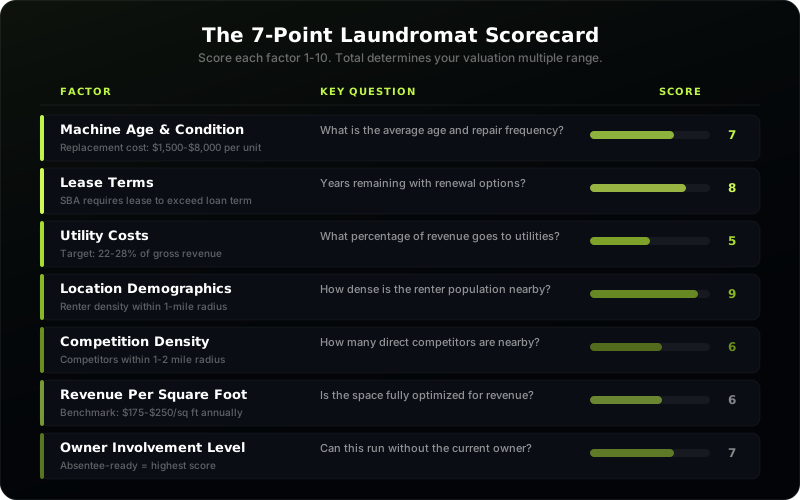
Factor 1: Machine Age and Condition (Score 1-10)
This is the single largest capital risk in any laundromat acquisition.
| Score | Criteria |
|---|---|
| 1-3 | Average machine age over 10 years, visible wear, frequent breakdowns, end-of-life components |
| 4-6 | Average age 5-10 years, functional but will need rolling replacements within 3-5 years |
| 7-9 | Average age under 5 years, well-maintained, service records available |
| 10 | Under 3 years old, manufacturer warranty active, complete service history |
Why it matters: Replacing a full machine fleet costs $150,000 to $400,000 depending on size. If you buy a laundromat at a 2.5x multiple and need to invest another $200,000 in machines within two years, your effective multiple just jumped to 4x or higher. Factor machine replacement into your total acquisition cost, not as an afterthought.
Factor 2: Lease Terms (Score 1-10)
The lease is the second most important factor. You do not own the building — you own the right to operate in a specific location. If that right expires, your business is worth scrap metal.
| Score | Criteria |
|---|---|
| 1-3 | Under 3 years remaining, no options to renew, above-market rent, landlord uncooperative |
| 4-6 | 3-7 years remaining, one renewal option, market-rate rent |
| 7-9 | 7-12 years remaining with options, below-market rent, good landlord relationship |
| 10 | 10+ years remaining, multiple renewal options, favorable rent with reasonable escalation clauses |
Why it matters: Banks and SBA lenders will not finance a laundromat acquisition if the remaining lease term does not cover the loan repayment period. A short lease also destroys your exit value. Negotiate the lease before you close.
Factor 3: Utility Costs (Score 1-10)
Utilities are the largest operating expense in a laundromat, typically consuming 25% to 35% of gross revenue. Water, gas, and electricity costs vary dramatically by region and by the efficiency of the equipment.
| Score | Criteria |
|---|---|
| 1-3 | Utilities exceeding 35% of revenue, old inefficient machines, high local utility rates, no efficiency upgrades |
| 4-6 | Utilities at 28-35% of revenue, some efficient machines, average local rates |
| 7-9 | Utilities at 22-28% of revenue, mostly high-efficiency equipment, competitive rates |
| 10 | Utilities under 22% of revenue, all high-efficiency machines, solar or other cost offsets |
Why it matters: A 10% difference in utility cost percentage on a $300K revenue laundromat is $30,000 per year straight to the bottom line. Newer high-efficiency machines can cut water usage by 40% and gas usage by 30% compared to equipment from 2010 or earlier.
Factor 4: Location Demographics (Score 1-10)
You cannot improve the location. This is the one factor you must get right at acquisition because it is the one factor you cannot change afterward.
| Score | Criteria |
|---|---|
| 1-3 | Declining population, high homeownership with in-unit laundry, poor visibility, limited parking |
| 4-6 | Stable population, mixed housing, adequate visibility and access |
| 7-9 | Growing population, high renter density, excellent visibility, strong foot traffic, anchored retail center |
| 10 | Dense urban renter population, no in-unit laundry in surrounding apartments, high-traffic anchor tenants, transit-adjacent |
Why it matters: The Coin Laundry Association data shows that the strongest performing laundromats are within one mile of apartment complexes with 500+ units that lack in-unit laundry. Pull census data. Drive the trade area. Count the apartment buildings. This is not something you eyeball.
Factor 5: Competition Density (Score 1-10)
| Score | Criteria |
|---|---|
| 1-3 | Three or more competitors within one mile, new build-outs in progress, price war dynamics |
| 4-6 | One to two competitors, stable competitive environment, differentiated by hours or services |
| 7-9 | One weak competitor or no direct competition within one mile |
| 10 | No competition within two miles, geographic or demographic barriers to new entry |
Why it matters: Laundromats have limited moats. If a new competitor opens across the street with newer machines and better parking, your revenue can drop 30% in six months. Low competition density is one of the most valuable attributes a laundromat can have.
Factor 6: Revenue Per Square Foot (Score 1-10)
This metric tells you whether the current owner is maximizing the space or leaving money on the table.
| Score | Criteria |
|---|---|
| 1-3 | Under $100/sq ft annually, significant unused space, poor machine layout |
| 4-6 | $100-$175/sq ft annually, reasonable utilization, standard layout |
| 7-9 | $175-$250/sq ft annually, optimized layout, ancillary revenue streams (vending, wash-dry-fold) |
| 10 | Over $250/sq ft annually, fully optimized, multiple revenue streams, strong wash-dry-fold operation |
Why it matters: A laundromat with low revenue per square foot under current ownership might actually be a better acquisition target than a fully optimized one. If you can identify why utilization is low — poor machine mix, no wash-dry-fold service, bad pricing — and you have a plan to fix it, you are buying upside that the current valuation does not reflect.
Factor 7: Owner Involvement Level (Score 1-10)
This factor measures how dependent the business is on the current owner's daily involvement. For more on evaluating operator dependency, see our guide on what to do in the first 90 days after buying a business.
| Score | Criteria |
|---|---|
| 1-3 | Owner works 40+ hours per week on-site, no employees, no systems, owner does all maintenance |
| 4-6 | Owner works 15-25 hours per week, one to two part-time employees, basic systems in place |
| 7-9 | Owner works under 10 hours per week, reliable staff, documented processes, third-party maintenance |
| 10 | Fully absentee, manager in place, all processes documented and delegated, owner visits monthly |
Why it matters: A laundromat where the owner works 50 hours a week is not generating $120K in SDE — it is generating $120K minus the cost of replacing those 50 hours. If you plan to be semi-absentee, you need to subtract $35,000 to $55,000 for a manager or attendant from the SDE before applying your multiple.
Scorecard Interpretation
| Total Score (out of 70) | Rating | Recommended Multiple |
|---|---|---|
| 55-70 | Exceptional | 3.0x - 3.5x SDE |
| 45-54 | Strong | 2.6x - 3.0x SDE |
| 35-44 | Average | 2.2x - 2.6x SDE |
| 25-34 | Below Average | 1.8x - 2.2x SDE |
| Below 25 | Distressed | Asset value only or below 1.8x SDE |
How to use it: Score each factor honestly. Add the scores. Find your range. Then use the SDE multiple from that range in your offer. If the seller wants a 3.2x multiple but your scorecard puts the business at a 38 (Average), you have a data-driven basis for offering 2.4x and explaining exactly why.
Real-World Valuation Walkthrough
Let us put the full framework together with a realistic example.
The deal: A laundromat listed at $425,000. The seller claims $160,000 in SDE. The business grosses $340,000 per year.
Step 1: Verify the SDE.
You reconstruct SDE from tax returns and bank deposits. Verified revenue is $310,000 (the seller was counting some vending income that belonged to a separate entity). After proper add-backs, reconstructed SDE is $128,000.
Step 2: Run the 7-Point Scorecard.
| Factor | Score | Notes |
|---|---|---|
| Machine Age/Condition | 5 | Average age 8 years, functional but approaching replacement cycle |
| Lease Terms | 7 | 9 years remaining with one 5-year option, slightly below market rent |
| Utility Costs | 4 | Utilities at 32% of revenue, older equipment driving high water/gas costs |
| Location Demographics | 8 | Dense renter neighborhood, 1,200 apartment units within half a mile |
| Competition Density | 6 | One competitor 0.8 miles away, older facility |
| Revenue Per Square Foot | 5 | $145/sq ft, no wash-dry-fold service currently offered |
| Owner Involvement | 6 | Owner works about 20 hours/week, one part-time attendant |
| Total | 41 | Average — recommended multiple 2.2x to 2.6x |
Step 3: Calculate the valuation range.
- Low: $128,000 x 2.2 = $281,600
- Mid: $128,000 x 2.4 = $307,200
- High: $128,000 x 2.6 = $332,800
Step 4: Cross-check with other methods.
- Asset-based: Equipment valued at approximately $110,000. Plus leasehold improvements and systems, roughly $135,000 total.
- Revenue multiple: $310,000 x 1.0 = $310,000
All three methods converge around $300,000 to $330,000.
Step 5: Factor in capital expenditure needs.
The machines are 8 years old. Within 4 years, you will need to start replacing them. Budget $120,000 for a phased replacement program. Your total cost of ownership is $300,000 (acquisition) + $120,000 (CapEx) = $420,000 over the first 5 years.
The verdict: The seller's asking price of $425,000 is roughly $100,000 too high based on verified SDE and your scorecard analysis. Your opening offer should be in the $290,000 to $310,000 range, with clear documentation supporting the number. For negotiation strategies, including how to structure seller financing to bridge valuation gaps, see our dedicated guide.
Common Laundromat Valuation Mistakes
Mistake 1: Trusting Unverified Cash Revenue
Many laundromats still have significant coin-operated revenue. Some sellers will claim cash income that does not show up in bank deposits. The rule is simple: if you cannot trace it to a deposit, it does not exist for valuation purposes. Period.
Mistake 2: Ignoring the CapEx Cliff
A laundromat with 12-year-old machines and an SDE of $150,000 is not worth 2.5x ($375,000). It is worth 2.5x minus the cost of replacing those machines within 1-3 years. If full replacement costs $250,000, the adjusted value is closer to $125,000 to $200,000. This is the single most common overpayment trap in laundromat acquisitions.
Mistake 3: Overvaluing Wash-Dry-Fold Upside
Buyers love to say "I will add wash-dry-fold and double the revenue." Maybe. But wash-dry-fold is labor-intensive, requires hiring and training staff, and has thinner margins than self-service. Value the business on its current performance. Model the upside separately and do not pay the seller for revenue you have not created yet.
Mistake 4: Ignoring Lease Risk
A laundromat with 2 years left on the lease and no renewal options is an asset purchase, not a business purchase. Value it accordingly. You are buying machines and a customer base that may not exist once the lease expires.
Mistake 5: Using National Averages for Local Businesses
A laundromat in San Francisco and a laundromat in rural Arkansas operate in completely different economic realities. Utility costs, labor rates, rent, competition, and customer demographics vary enormously. Use local comparables and local operating data, not national averages from industry reports.
Financing Your Laundromat Acquisition
Most laundromat acquisitions in the $200K to $500K range use one of three financing structures. For a complete breakdown of SBA loan requirements and strategies, see our dedicated guide.
SBA 7(a) Loan: The most common path. Requires 10-20% down payment, demonstrated cash flow to cover debt service at 1.25x, and a remaining lease term that exceeds the loan term. The SBA caps 7(a) loans at $5 million, which is well above what most laundromat deals require.
Seller Financing: Often the best option, especially when the seller is motivated and the deal does not fully qualify for SBA financing. Typical terms are 10-20% down, 5-7 year amortization, and interest rates between 6-9%. Seller financing also signals that the seller believes in the business's continued performance.
Combination: 60-70% SBA financing, 10-20% seller note, 10-20% buyer equity. This is the optimal structure for most deals because it minimizes your cash outlay while satisfying the SBA's equity injection requirements.
Due Diligence Checklist Specific to Laundromats
Beyond the standard business acquisition due diligence checklist, laundromats require industry-specific verification. For comparison with another asset-heavy industry, see our guide on how to value an HVAC business.
Equipment audit:
- Serial numbers, ages, and model numbers for every machine
- Maintenance records and repair history
- Manufacturer warranty status
- Parts availability (some older models have discontinued parts)
- Average vend price per machine versus local market rates
Utility verification:
- 24 months of water, gas, and electric bills
- Cost per pound of laundry processed (benchmark: $0.15-$0.25/lb for utilities)
- Any pending rate increases from utility providers
- Efficiency ratings of current equipment versus available replacements
Lease deep dive:
- Remaining term plus all renewal options
- Rent escalation clauses (fixed percentage vs. CPI-linked)
- Exclusive use clause (does the lease prevent the landlord from leasing to another laundromat?)
- Assignment provisions (can you transfer the lease without landlord approval?)
- CAM charges and property tax pass-throughs
Revenue verification:
- Card system reports (if applicable) for the last 24 months
- Coin collection logs or safe counts
- Vending machine revenue records
- Wash-dry-fold revenue by month (if applicable)
- Peak hours and seasonal patterns
Frequently Asked Questions
How much does a laundromat make per year?
A typical self-service laundromat generates between $200,000 and $500,000 in gross revenue annually, depending on size, location, and machine count. After operating expenses (utilities at 25-35% of revenue, rent at 15-25%, labor, insurance, and maintenance), the owner's discretionary earnings typically range from $60,000 to $180,000 for a mid-sized operation with 30 to 50 machines. Laundromats with active wash-dry-fold services can push gross revenue above $500,000, though margins on that service are lower due to labor costs.
What is a good ROI for a laundromat?
A well-purchased laundromat should deliver a cash-on-cash return of 15% to 30% annually after debt service. If you buy a $300,000 laundromat with $60,000 down (using SBA financing), and it generates $120,000 in SDE minus $48,000 in annual debt service, your pre-tax cash flow is $72,000 on a $60,000 investment — a 120% cash-on-cash return. However, those numbers assume no major capital expenditures. Once you factor in a machine replacement reserve of $15,000 to $25,000 per year, realistic cash-on-cash returns settle in the 25-40% range for a good deal, which is still exceptional compared to most alternative investments.
How much does it cost to buy a laundromat?
According to BizBuySell and industry data, laundromat sale prices typically range from $150,000 for a small, older location to $1,000,000+ for a premium, high-volume operation. The median sale price for a mid-sized laundromat is approximately $300,000 to $400,000. Total acquisition costs including closing costs, working capital, and an initial CapEx reserve typically add 15-25% to the purchase price. So a $350,000 laundromat really costs $400,000 to $440,000 to get into fully capitalized.
Can you buy a laundromat with no money down?
Technically possible but practically inadvisable. Some buyers structure 100% seller-financed deals, but this signals to the seller that you have no skin in the game, which makes them less likely to agree. The SBA requires a minimum 10% equity injection, which can sometimes come from a combination of your cash, a seller note on standby, and retirement funds via a ROBS (Rollover for Business Startups) arrangement. A better question than "can I buy with no money down" is "what is the minimum I need to put down while still having enough working capital to survive the first six months?"
How long does it take a laundromat to pay for itself?
With a typical SDE multiple of 2.5x, the business generates enough discretionary earnings to cover its purchase price in 2.5 years — before financing costs. After financing, most well-purchased laundromats achieve full payback of the buyer's equity within 2 to 4 years. This assumes stable operations and no major surprise capital expenditures. Budget conservatively and assume a 4-year payback to give yourself margin for the unexpected.
Putting It All Together
Valuing a laundromat is not about plugging a number into a formula. It is about combining quantitative analysis (SDE multiples, asset valuation, revenue multiples) with qualitative scoring (the 7-Point Scorecard) and industry-specific due diligence to arrive at a number you can defend to a seller, a bank, and yourself.
The buyers who win in this space share three traits: they verify everything independently, they account for future capital expenditure in their valuation, and they buy based on what the business is — not what they hope it could become.
If you are evaluating a laundromat deal right now and want to run the numbers through a structured framework, BuyBox was built for exactly this kind of analysis. It takes the scorecard methodology described in this guide and turns it into a repeatable system you can apply to every deal in your pipeline.
This guide is part of our deal evaluation series. For foundational concepts on valuing any small business, start with our guides on due diligence and SBA financing.
Brandon Quijano
Acquisition strategist & builder of BuyBox