How to Value an HVAC Business for Acquisition
What an HVAC Company Is Actually Worth (And Why Most Buyers Overpay)
If you are looking at HVAC business valuation multiples and trying to figure out what a heating and cooling company is actually worth, you have already discovered the frustrating range of answers floating around online. Brokers will tell you 3x to 5x earnings. Sellers will point to their truck fleet and customer list and claim the number should be higher. Accountants will run a discounted cash flow model that tells you nothing about what makes HVAC companies specifically valuable or risky.
The truth is that HVAC business valuation is more nuanced than most service businesses because it combines recurring revenue mechanics (service agreements), heavy capital assets (fleet and equipment), licensed human capital (EPA-certified technicians), and extreme seasonality into a single operation. Getting any one of these factors wrong in your analysis can lead to a six-figure mistake on acquisition day.
I have evaluated HVAC companies across the $500K to $3M revenue range, and the pattern is consistent: buyers who overpay almost always miscalculate one of two things — the real value of the service agreement base, or the true cost of replacing the fleet and workforce. Buyers who find great deals understand that an HVAC company is really three businesses stitched together: a recurring maintenance business, a project-based installation business, and a fleet management operation.
This guide gives you the framework to value all three. By the end, you will know how to calculate a defensible HVAC valuation, how to score a company using the 8-factor HVAC Acquisition Scorecard, and how to avoid the traps that turn a good deal into a money pit.
An HVAC company with a locked-in service agreement base is the best boring business you can buy — predictable revenue, high switching costs, and customers who call you before they call anyone else.
Why HVAC Businesses Command Premium Multiples
HVAC companies trade at higher multiples than most service businesses, and there are structural reasons for that premium. Understanding those reasons is the first step to knowing whether a specific company deserves them.
Recurring revenue through service agreements. A well-run HVAC company generates 25% to 45% of its revenue from maintenance agreements — customers paying $150 to $300 per year for biannual tune-ups and priority service. That recurring revenue base is what separates a 2.5x deal from a 4.5x deal. According to ACHR News, companies with service agreement penetration above 40% of their residential customer base consistently command multiples at the top of the range.
Licensed workforce scarcity. HVAC technicians require EPA 608 certification to handle refrigerants, and many states require additional licensing. The Bureau of Labor Statistics projects 6% job growth for HVAC technicians through 2032, but training pipelines are not keeping up. A company with 8 tenured, licensed technicians is not just selling capacity — it is selling a workforce that would take you 2 to 3 years to recruit and train from scratch. Technician salaries typically range from $55,000 to $85,000 depending on experience and region.
Equipment brand authorizations. Authorized dealerships with Carrier, Trane, Lennox, or Daikin create a meaningful competitive advantage. Customers search for authorized dealers when making $8,000 to $15,000 equipment purchases. Those authorizations come with marketing support, warranty labor reimbursement, and priority parts access. Losing them post-acquisition can cost 15% to 25% of installation revenue.
Essential service demand. People delay discretionary purchases during recessions. They do not delay replacing a failed furnace in January or a dead AC compressor in August. HVAC demand is structurally resilient, which is why well-run HVAC companies maintained margins through 2008-2009 and the 2020 disruption.
HVAC Valuation Multiples: What the Data Actually Shows
The most common valuation method for HVAC companies in the $500K to $3M revenue range is the SDE (Seller's Discretionary Earnings) multiple. Here is what you should expect to see, based on current market data from BizBuySell and industry transactions.
Step 1: Reconstruct the SDE.
Do not use the seller's number. Reconstruct it from tax returns and bank statements. For a complete walkthrough of SDE reconstruction methodology, see our due diligence checklist.
Start with net income from the tax return. Add back:
- Owner salary and all benefits
- Vehicle expenses for owner's personal-use truck
- One-time expenses (legal fees, unusual repairs) with documentation
- Depreciation and amortization
- Interest on seller's debt
- Personal expenses run through the business (cell phone, insurance, etc.)
For HVAC companies specifically, pay close attention to how the owner categorizes equipment purchases. Some owners expense equipment that should be capitalized, artificially deflating net income. Others capitalize repairs that should be expensed, inflating reported earnings. Cross-reference equipment purchases against IRS MACRS depreciation schedules to verify.
Step 2: Apply the multiple.
| Multiple Range | Business Profile |
|---|---|
| 2.5x - 3.0x | Owner-operator dependent, minimal service agreements, aging fleet, residential-only, limited brand authorizations |
| 3.0x - 3.5x | Some service agreements (15-25% of revenue), stable workforce, mixed residential/light commercial, adequate fleet |
| 3.5x - 4.0x | Strong service agreement base (25-40%), tenured techs, brand authorizations, newer fleet, documented systems |
| 4.0x - 4.5x | Exceptional recurring revenue (40%+), fully systematized operations, commercial contracts, modern fleet, strong brand, owner semi-absentee |
Example: An HVAC company with $1.8M in revenue, verified SDE of $280,000, a service agreement base generating 32% of revenue, 6 technicians with average tenure of 4 years, a fleet averaging 5 years old, and Carrier/Lennox authorized dealer status would fall in the 3.5x to 4.0x range. Valuation: $980,000 to $1,120,000.
Why the range is higher than laundromats. HVAC companies command 2.5x to 4.5x versus 2.0x to 3.5x for laundromats because they have stronger recurring revenue mechanics, higher barriers to entry (licensing requirements), and more defensible customer relationships. The tradeoff is higher operational complexity and greater dependence on human capital.
The HVAC Acquisition Scorecard
This is the framework I developed after seeing too many buyers fixate on topline revenue or SDE while ignoring the structural factors that determine whether an HVAC company will perform at, above, or below its historical numbers under new ownership.
The scorecard evaluates eight factors. Each is scored 1 through 10. The total score maps to a recommended multiple range, giving you a data-driven basis for your offer price.
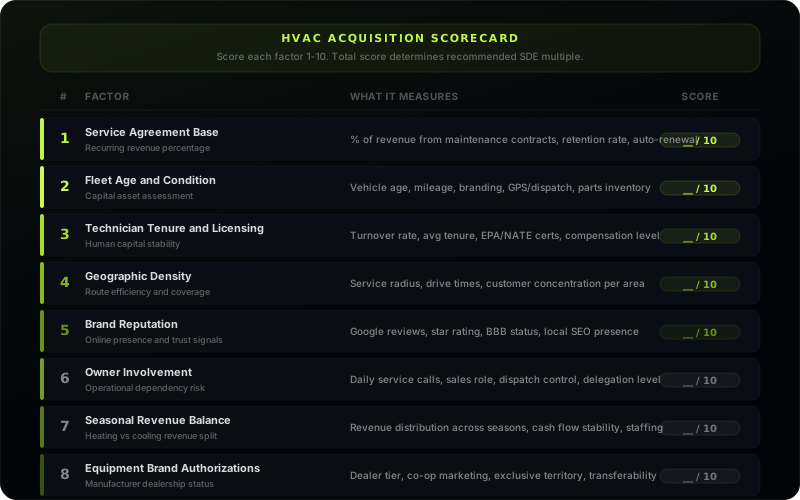
Factor 1: Service Agreement Base — Recurring Revenue Percentage (Score 1-10)
This is the single most important factor in HVAC valuation. Service agreements create predictable revenue, reduce customer acquisition costs, and generate high-margin upsell opportunities when technicians find issues during maintenance visits.
| Score | Criteria |
|---|---|
| 1-3 | Under 15% of revenue from service agreements, fewer than 200 agreements, high churn rate, no automatic renewals |
| 4-6 | 15-30% of revenue from service agreements, 200-500 agreements, moderate retention, basic renewal process |
| 7-9 | 30-45% of revenue, 500-1,000 agreements, 80%+ retention rate, auto-renewal with credit card on file |
| 10 | Over 45% of revenue, 1,000+ agreements, 90%+ retention, automated billing, multi-year contracts common |
Why it matters: Each service agreement customer is worth $150 to $300 per year in direct agreement revenue, plus an estimated $400 to $800 per year in repair and replacement upsell revenue. A base of 600 agreements is not just $120,000 in recurring revenue — it is a $360,000 to $660,000 annual revenue stream when you factor in the work those maintenance visits generate. Buyers who do not properly value the service agreement base leave money on the table. Buyers who overpay for a weak agreement base end up subsidizing customer acquisition they thought was already done.
Factor 2: Fleet Age and Condition (Score 1-10)
The fleet is the second largest capital asset after the workforce. HVAC service vehicles are not just transportation — they are rolling workshops carrying $8,000 to $15,000 in parts inventory each.
| Score | Criteria |
|---|---|
| 1-3 | Average fleet age over 8 years, vehicles over 150K miles, frequent breakdowns, no GPS/routing, no uniform branding |
| 4-6 | Average age 5-8 years, vehicles at 80K-150K miles, functional but approaching replacement, basic tracking |
| 7-9 | Average age 3-5 years, well-maintained, GPS routing, branded wraps, organized parts inventory, service records |
| 10 | Under 3 years old, warranty active, full GPS/dispatch integration, professionally branded, complete maintenance records |
Why it matters: A fully equipped HVAC service vehicle costs $40,000 to $60,000 to purchase, outfit, and stock with parts inventory. A company with 8 trucks that need replacement within 2 years has a $320,000 to $480,000 capital expenditure lurking behind the SDE number. That cost must be subtracted from your valuation or factored into your total acquisition cost. Check the IRS Section 179 deduction for vehicle depreciation — you may be able to accelerate the write-off on replacement vehicles, but the cash still goes out the door.
Factor 3: Technician Tenure and Licensing (Score 1-10)
In HVAC, the technicians are the product. Customers build relationships with the tech who services their system, and those relationships drive referral revenue and service agreement renewals.
| Score | Criteria |
|---|---|
| 1-3 | High turnover (over 30% annually), most techs under 2 years tenure, minimal certifications beyond basic EPA 608, no training program |
| 4-6 | Moderate turnover (15-30%), average tenure 2-4 years, EPA certified, some manufacturer training, competitive but not leading compensation |
| 7-9 | Low turnover (under 15%), average tenure 4-7 years, NATE certified, manufacturer training current, above-market compensation, clear advancement path |
| 10 | Minimal turnover, average tenure 7+ years, NATE and manufacturer certified, ongoing training budget, top-of-market compensation, key techs with equity or retention agreements |
Why it matters: According to Bureau of Labor Statistics data, the median annual wage for HVAC mechanics and installers is approximately $57,300, with the top 10% earning over $80,000. Replacing a skilled HVAC technician costs 1.5x to 2x their annual salary when you factor in recruiting, training, lost productivity, and customer relationship disruption. A company where 3 of 6 technicians leave within 12 months of the acquisition — a common scenario when ownership changes — will see immediate revenue impact and customer attrition. Retention risk is valuation risk.
Factor 4: Geographic Density of Customer Base (Score 1-10)
Route density directly impacts profitability. An HVAC company where the average drive time between calls is 12 minutes completes more calls per day than one where techs drive 35 minutes between appointments.
| Score | Criteria |
|---|---|
| 1-3 | Customers spread across 50+ mile radius, average drive time between calls over 30 minutes, rural or exurban service area |
| 4-6 | Service area within 30-mile radius, moderate density, 20-30 minute average drive times, suburban |
| 7-9 | Concentrated within 20-mile radius, dense suburban or urban customer base, 12-20 minute average drive times, efficient routing |
| 10 | Hyper-concentrated within 15-mile radius, dense urban/suburban, under 12 minute average drive times, neighborhood dominance with multiple customers per street |
Why it matters: A technician who completes 6 calls per day versus 4 calls per day due to shorter drive times generates 50% more revenue on the same labor cost. Over a year, across a 6-technician team, that density advantage can represent $200,000 to $400,000 in additional revenue capacity. Geographic density also reduces fuel costs, fleet wear, and response time — which drives better Google reviews and higher service agreement retention.
Factor 5: Brand Reputation — Google Reviews and BBB Rating (Score 1-10)
In HVAC, online reputation is a direct revenue driver. Homeowners facing a $6,000 to $15,000 equipment purchase spend significant time reading reviews before choosing a contractor.
| Score | Criteria |
|---|---|
| 1-3 | Under 50 Google reviews, below 4.0 stars, BBB complaints unresolved, negative reputation on Yelp/Angi, no review generation system |
| 4-6 | 50-150 Google reviews, 4.0-4.4 stars, BBB accredited, mixed reviews, basic review request process |
| 7-9 | 150-500 Google reviews, 4.5+ stars, BBB A rating, active review generation, strong Angi/HomeAdvisor presence |
| 10 | 500+ Google reviews, 4.7+ stars, BBB A+ rating, systematic review generation after every call, dominant local search presence, community recognition |
Why it matters: HVAC companies with 4.5+ stars and 200+ Google reviews generate 30% to 50% more inbound calls than competitors with weaker profiles, according to local SEO industry data. That organic lead flow reduces customer acquisition cost from $150 to $300 per lead (paid) to $20 to $40 per lead (organic/referral). When you acquire a company with strong reviews, you are acquiring a marketing asset that would take 3 to 5 years to build from scratch. Conversely, acquiring a company with a damaged online reputation means you are inheriting a liability that will suppress lead flow until you repair it.
Factor 6: Owner Involvement in Daily Service Calls (Score 1-10)
This factor measures operational dependency on the current owner. For more on evaluating operator dependency and managing transitions, see our guide on what to do in the first 90 days after buying a business.
| Score | Criteria |
|---|---|
| 1-3 | Owner runs 3+ service calls per day, is the primary salesperson for installations, handles all dispatching, customers ask for the owner by name |
| 4-6 | Owner runs 1-2 calls per day, involved in installation sales, manages dispatch but has office help, some customer relationships are owner-dependent |
| 7-9 | Owner runs no service calls, has a service manager handling dispatch and customer issues, involved mainly in installation sales and business development |
| 10 | Owner fully absentee, general manager runs daily operations, installation sales handled by dedicated salesperson, all processes documented and delegated |
Why it matters: An HVAC company where the owner personally generates $400,000 in annual revenue through service calls and installation sales is not generating SDE of $280,000 — it is generating $280,000 minus the cost of replacing those revenue-producing activities. If replacing the owner's production capacity requires hiring a service manager ($65,000 to $85,000) and an installation sales rep ($50,000 base plus commission), your effective SDE drops by $115,000 to $135,000 before you even apply a multiple. This is the most common source of overpayment in HVAC acquisitions.
Factor 7: Seasonal Revenue Balance — Heating vs. Cooling (Score 1-10)
HVAC is inherently seasonal, but the severity of that seasonality varies enormously based on geography and service mix.
| Score | Criteria |
|---|---|
| 1-3 | 70%+ of revenue in one season (cooling-only in Sun Belt or heating-only in far north), severe cash flow troughs, layoffs during off-season |
| 4-6 | 60/40 split between primary and secondary season, manageable cash flow variation, some revenue in shoulder months from maintenance |
| 7-9 | 55/45 or better seasonal split, service agreements smooth revenue across months, indoor air quality or ductwork services fill shoulder seasons |
| 10 | Nearly balanced seasonal revenue, commercial contracts with year-round service requirements, diversified services (plumbing, electrical) create off-season revenue |
Why it matters: Seasonal concentration creates cash flow valleys that strain working capital, force layoffs (which cost you trained technicians), and compress margins due to overtime costs during peak season. A company with balanced seasonality is easier to finance, easier to staff, and easier to value. Lenders, particularly SBA lenders, factor seasonal cash flow patterns into debt coverage ratio calculations. If your monthly loan payment is $8,000 but February revenue drops to $35,000, your debt coverage ratio may violate loan covenants during the trough.
Factor 8: Equipment Brand Authorizations and Dealerships (Score 1-10)
Brand authorizations are a misunderstood asset. They are not just logos on your website — they represent preferred access to customers, parts, training, and warranty labor revenue.
| Score | Criteria |
|---|---|
| 1-3 | No manufacturer authorizations, purchases equipment through distribution only, no warranty labor program, competes on price alone |
| 4-6 | One manufacturer authorization, basic parts access, limited warranty labor, some co-op marketing funds |
| 7-9 | Two or more major manufacturer authorizations (Carrier, Trane, Lennox, etc.), active warranty labor program, co-op marketing, priority parts access, dealer-exclusive models |
| 10 | Premier/elite dealer status with multiple manufacturers, exclusive territory agreements, new construction builder relationships, factory training sponsorship, top-tier co-op marketing |
Why it matters: An authorized Carrier dealer with elite status receives 5% to 10% better pricing on equipment, $5,000 to $20,000 per year in co-op marketing funds, access to dealer-exclusive product lines, and manufacturer-driven leads. Those authorizations are typically tied to volume commitments and training requirements. If the acquisition disrupts the relationship — and it can, if the manufacturer does not approve the ownership transfer — you lose a competitive advantage that took years to build. Verify transferability of all dealer agreements during due diligence.
Scorecard Interpretation
| Total Score (out of 80) | Rating | Recommended Multiple |
|---|---|---|
| 65-80 | Exceptional | 4.0x - 4.5x SDE |
| 50-64 | Strong | 3.5x - 4.0x SDE |
| 38-49 | Average | 3.0x - 3.5x SDE |
| 25-37 | Below Average | 2.5x - 3.0x SDE |
| Below 25 | Distressed | Below 2.5x SDE or asset value only |
How to use it: Score each factor honestly. Add the scores. Find your range. Then use the SDE multiple from that range as your starting point. If the seller wants a 4.0x multiple but your scorecard puts the business at a 42 (Average), you have a data-driven basis for offering 3.2x and explaining exactly why. The scorecard removes emotion from the negotiation and replaces it with structured analysis. For negotiation strategies to bridge valuation gaps, see our guide on seller financing.
Real-World HVAC Valuation Walkthrough
Let us put the full framework together with a realistic deal scenario.
The deal: An HVAC company listed at $1,250,000. The seller claims $320,000 in SDE. The business grosses $2.1M per year. Located in a mid-size southeastern city with both heating and cooling demand.
Step 1: Verify the SDE.
You reconstruct SDE from 3 years of tax returns and bank statements. The seller has been running $28,000 per year in personal vehicle expenses through the business and expensing $35,000 in equipment that should be capitalized. After proper add-backs and adjustments, verified SDE is $275,000.
Step 2: Run the HVAC Acquisition Scorecard.
| Factor | Score | Notes |
|---|---|---|
| Service Agreement Base | 6 | 420 agreements, 24% of revenue, 75% retention, manual renewal process |
| Fleet Age and Condition | 5 | 7 trucks averaging 6 years old, basic GPS, branded but worn wraps, 2 trucks need replacement within 18 months |
| Technician Tenure and Licensing | 7 | 6 techs, average tenure 5 years, all EPA 608, 4 with NATE certification, compensation slightly above market |
| Geographic Density | 7 | 85% of customers within 18-mile radius, suburban, 15-minute average drive times |
| Brand Reputation | 6 | 180 Google reviews, 4.3 stars, BBB A- rating, some unanswered negative reviews |
| Owner Involvement | 4 | Owner runs 1-2 calls per day, handles all installation sales, relationship-driven — customers request him |
| Seasonal Revenue Balance | 7 | Southeast location gives 55/45 cooling-to-heating split, maintenance agreements smooth shoulder seasons |
| Equipment Brand Authorizations | 5 | Carrier authorized dealer, basic tier, no exclusive territory, limited co-op marketing usage |
| Total | 47 | Average — recommended multiple 3.0x to 3.5x |
Step 3: Calculate the valuation range.
- Low: $275,000 x 3.0 = $825,000
- Mid: $275,000 x 3.25 = $893,750
- High: $275,000 x 3.5 = $962,500
Step 4: Factor in capital expenditure and transition costs.
- Two truck replacements within 18 months: $100,000 to $120,000
- Service manager hire to replace owner's field time: $75,000 per year ongoing cost (reduces effective SDE)
- Fleet wrap refresh: $12,000 to $18,000
- CRM/dispatch system upgrade: $15,000 to $25,000
The owner involvement score of 4 is the critical risk factor. You need to reduce the SDE by the cost of replacing the owner's production, which brings the adjusted SDE to approximately $200,000 to $215,000. At a 3.25x multiple on adjusted SDE: $650,000 to $700,000.
The verdict: The seller's asking price of $1,250,000 is roughly $550,000 too high when you properly account for owner dependency and near-term capital expenditure. Your opening offer should be in the $700,000 to $750,000 range, with a clear breakdown showing adjusted SDE, scorecard-driven multiple, and capital reserve requirements. If the seller pushes back, propose seller financing to bridge the gap — $750,000 total, with $500,000 at closing (SBA financed) and $250,000 on a 4-year seller note contingent on customer retention metrics.
What Drives HVAC Valuations Up
Recurring revenue above 35% of total. This is the single highest-leverage factor. Every percentage point of recurring revenue above 35% pushes the multiple upward because it reduces revenue volatility and customer acquisition cost. If you are evaluating two companies with identical SDE but one has 20% recurring and the other has 40% recurring, the second company is worth 0.5x to 1.0x more in multiple terms.
Licensed technicians with long tenure. A stable workforce eliminates the most expensive and unpredictable cost in HVAC — turnover. Companies with average technician tenure above 5 years signal healthy culture, competitive compensation, and low disruption risk post-acquisition.
Multiple brand authorizations at high tier. Premier dealer status with two or more manufacturers creates pricing advantages, marketing support, and customer trust that compounds over time. These relationships take 3 to 5 years to build and represent real competitive moat.
Commercial contract mix. Commercial HVAC contracts (office buildings, retail, light industrial) typically generate higher margins, smoother seasonality, and longer customer relationships than residential. A company with 30% to 40% commercial mix commands a premium.
Documented systems and processes. An HVAC company with documented SOPs, a real CRM with customer history, automated dispatch, and a trained office manager is a systematized business. An HVAC company where everything lives in the owner's head is a job that the owner is selling as a business.
What Drives HVAC Valuations Down
Owner-operator dependency. If the owner runs service calls, closes installation sales, and manages dispatch, you are buying a job, not a business. The multiple must reflect the cost of replacing those functions. This is the most common reason HVAC companies are overpriced — the SDE looks great until you realize half of it comes from the owner's personal production.
Aging fleet. A fleet of 8 trucks averaging 8 years old with 120,000+ miles each is a $400,000 liability hiding inside the SDE. Those trucks will need replacement, and the cost comes directly out of cash flow. Always subtract near-term fleet replacement costs from your valuation.
Seasonal concentration. A cooling-only company in Phoenix does 75% of its revenue in 5 months. During the other 7 months, it is bleeding cash to retain technicians and cover fixed costs. Seasonal concentration compresses multiples because it increases working capital requirements and lender risk.
Weak service agreement base. An HVAC company with fewer than 200 service agreements and no systematic renewal process is essentially a project-based business that happens to fix air conditioners. Project-based revenue is unpredictable, and unpredictable revenue commands lower multiples.
Customer concentration. If one commercial client or one property management relationship represents more than 15% of revenue, that is a concentration risk that must be reflected in the multiple. Losing that one customer post-acquisition could crater cash flow.
Residential vs. Commercial HVAC: Valuation Differences
The revenue mix between residential and commercial work significantly impacts how you value an HVAC company.
Residential HVAC is higher volume, lower ticket, more seasonal, and more dependent on marketing and online reputation. Average residential service call revenue is $250 to $500, and average residential installation revenue is $6,000 to $15,000. The upside of residential is scale — you can grow through marketing and service agreements without needing specialized engineering capabilities.
Commercial HVAC is lower volume, higher ticket, less seasonal, and more relationship-dependent. Commercial service contracts range from $5,000 to $50,000+ per year depending on building size and system complexity. The upside of commercial is margin stability and longer customer lifecycles (10+ years is common for commercial service relationships).
The sweet spot for acquisition is typically a company with 60% to 70% residential and 30% to 40% commercial. This mix gives you the recurring revenue stability of commercial contracts with the growth potential and marketing scalability of residential. Pure residential companies at the same SDE trade at 0.3x to 0.5x lower multiples than mixed companies, because residential-only revenue is more volatile and more owner-dependent.
Fleet and Inventory Assessment
The fleet deserves its own section because it is often the most under-analyzed asset in HVAC acquisitions.
Vehicle assessment checklist:
| Item | What to Verify |
|---|---|
| Title and registration | All vehicles titled to the business entity, not the owner personally |
| Mileage and condition | Service records, current mileage, body condition, mechanical inspection |
| Remaining useful life | Based on mileage and age, estimate years until replacement |
| Outfitting cost | Shelving, tool storage, ladder racks, parts bins — $5,000 to $10,000 per truck |
| Branding | Wraps or decals, condition, consistency across fleet |
| GPS and dispatch | Real-time tracking, integration with scheduling software |
| Insurance | Current coverage, claims history, any vehicles with lapsed registration |
Parts inventory assessment:
Most HVAC service trucks carry $8,000 to $15,000 in parts and materials. The warehouse may hold another $20,000 to $50,000. Verify the inventory is current-model compatible — $30,000 in parts for discontinued equipment lines is worth significantly less than its book value. Slow-moving or obsolete inventory should be valued at 30% to 50% of cost, not full book value.
Total fleet valuation example:
An 8-truck fleet averaging 5 years old with $12,000 per truck in parts inventory:
- Vehicle value: 8 trucks x $18,000 average current value = $144,000
- Outfitting: 8 trucks x $7,000 = $56,000
- Mobile inventory: 8 x $12,000 = $96,000
- Warehouse inventory: $35,000
- Total fleet and inventory asset value: $331,000
This number matters because it establishes the asset floor of the business. If the total asking price minus the fleet and inventory value leaves more than 70% of the price as goodwill, scrutinize the cash flow assumptions aggressively. For more on identifying red flags in deal evaluation, see our guide on deal autopsies from failed acquisitions.
HVAC Due Diligence: Industry-Specific Items
Beyond the standard business acquisition due diligence checklist, HVAC companies require additional verification in several areas.
Licensing and compliance:
- State and local HVAC contractor licenses — verify they transfer with the business or can be reissued to new ownership
- EPA 608 certifications for all technicians handling refrigerants
- Any pending code violations, permit issues, or incomplete inspections
- Workers compensation claims history and experience modification rate (EMR)
Service agreement analysis:
- Total number of active agreements and monthly/annual revenue
- Customer retention rate over the last 3 years
- Agreement terms — auto-renew vs. manual renewal, cancellation terms
- Average revenue per agreement including upsell from maintenance visits
- Geographic distribution of agreement customers
Manufacturer relationship verification:
- All dealer agreements and authorization certificates
- Volume commitments and whether the business is currently meeting them
- Transferability provisions — does the manufacturer need to approve new ownership
- Current tier status and risk of demotion post-acquisition
- Co-op marketing fund balance and usage history
Technology and systems:
- CRM/dispatching software (ServiceTitan, Housecall Pro, FieldEdge, etc.)
- Customer database quality — how many records, how complete, is contact info current
- Marketing automation — review request system, email campaigns, follow-up sequences
- Call recording and quality monitoring for inbound sales calls
Frequently Asked Questions
What is a good SDE multiple for an HVAC business?
HVAC businesses typically sell for 2.5x to 4.5x SDE, with the median around 3.0x to 3.5x for a company in the $500K to $3M revenue range. A multiple above 3.5x requires strong recurring revenue from service agreements (above 30% of total revenue), a stable and licensed workforce, modern fleet, manufacturer authorizations, and documented systems that do not depend on the owner. A multiple below 3.0x usually reflects owner-operator dependency, weak service agreement base, aging fleet, or seasonal concentration. The scorecard methodology in this guide will help you determine exactly where a specific company falls.
How important are service agreements in HVAC valuation?
Service agreements are the most important single factor in HVAC valuation. They represent predictable, recurring revenue with high margins and low customer acquisition costs. An HVAC company with 600 service agreements generating $180,000 per year in direct agreement revenue and an additional $360,000 in maintenance-driven repair and replacement revenue is fundamentally different from a company of similar size with no agreement base. The agreement base typically accounts for 0.5x to 1.0x of the difference in valuation multiples between comparable companies. During due diligence, verify the retention rate, average revenue per agreement, and whether agreements auto-renew or require manual renewal each year.
What should I look for in an HVAC company's fleet?
Focus on three things: remaining useful life, total cost to replace, and whether the fleet is properly outfitted and branded. A fully equipped HVAC service vehicle costs $40,000 to $60,000 to purchase, outfit with shelving and tool storage, wrap with branding, and stock with parts inventory. Multiply the number of vehicles needing replacement within 3 years by $50,000, and subtract that number from your valuation. Also verify that all vehicles are titled to the business (not the owner personally), have current registration and insurance, and carry adequate parts inventory. GPS tracking and dispatch integration indicate a systematized operation; lack of these suggests the owner is managing routes manually.
Is residential or commercial HVAC more valuable?
Commercial HVAC revenue is generally valued higher because it is more predictable (long-term contracts), less seasonal (year-round maintenance requirements), and less dependent on marketing spend. However, the ideal acquisition target typically has a mix — 60% to 70% residential and 30% to 40% commercial. Pure commercial companies are rare in the sub-$3M revenue range, and pure residential companies command lower multiples due to higher seasonality and customer acquisition costs. The commercial revenue provides stability while the residential base provides growth potential. During valuation, price commercial contract revenue at a slight premium to residential revenue when calculating the effective SDE multiple.
How do I finance an HVAC business acquisition?
Most HVAC acquisitions in the $500K to $1.5M range use SBA 7(a) financing as the primary debt instrument. The SBA requires 10% to 20% equity injection, a debt service coverage ratio of 1.25x or better, and demonstration that the business can service the loan from existing cash flow. For a deeper walkthrough of SBA requirements and strategies, see our SBA loan guide. Seller financing is common and often advantageous — typical terms are 10% to 20% of the purchase price on a 3 to 5 year note at 6% to 8% interest. The optimal structure is usually 70% SBA, 15% seller note, 15% buyer equity, which minimizes your cash outlay while satisfying SBA equity injection requirements and giving the seller confidence through the retained seller note.
Putting It All Together
Valuing an HVAC business is not about applying a generic multiple to a topline number. It is about decomposing the business into its three core components — the recurring maintenance operation, the project-based installation business, and the fleet and workforce asset base — and valuing each one based on structural factors that determine future performance.
The buyers who overpay make the same mistakes: they accept the seller's SDE at face value, they ignore the cost of replacing the owner's production, they underestimate fleet replacement costs, and they overvalue installation revenue relative to service agreement revenue.
The buyers who find great deals use a structured framework like the HVAC Acquisition Scorecard to quantify the qualitative factors that drive value. They verify everything independently, subtract capital expenditure requirements from their valuation, and build their offer on data rather than emotion.
If you are evaluating an HVAC deal right now and want to run the numbers through a structured framework, BuyBox was built for exactly this kind of analysis. It takes the scorecard methodology described in this guide and turns it into a repeatable system you can apply to every deal in your pipeline — whether it is an HVAC company, a laundromat, or any other service business.
This guide is part of our deal evaluation series. For foundational concepts on valuing any small business, start with our guides on due diligence and SBA financing.
Brandon Quijano
Acquisition strategist & builder of BuyBox