First 90 Days After Buying a Business: The Owner-Operator Survival Guide
You Bought the Business. Now What? (The Guide Nobody Writes)
Every acquisition blog on the internet will teach you how to find a deal, negotiate the purchase price, and close the transaction. Almost none of them tell you what to do in the first 90 days after buying a business — the period that determines whether your acquisition becomes a wealth-building asset or an expensive lesson. The closing was the easy part. What comes next is where most new owners fail.
The statistics are sobering. According to Harvard Business Review, between 70% and 90% of acquisitions fail to deliver expected value, and the majority of those failures trace directly to poor post-acquisition integration — not bad deal selection. You can buy the right business at the right price with perfect due diligence and still destroy it in the first three months if you do not have a transition playbook.
This guide is that playbook. It is built on the framework I call The 90-Day Integration Sprint — a phased approach that prevents the two most common post-acquisition disasters: moving too fast and alienating the team, or moving too slowly and losing momentum.
The deal was the audition. The first 90 days is the performance. And the audience — your employees, customers, and vendors — will decide in weeks whether you deserve an encore.
Why the First 90 Days Make or Break Your Acquisition
The transition period after a business acquisition is uniquely fragile. Unlike a startup where you are building from nothing, you have inherited a living organism — with habits, relationships, culture, and momentum that existed long before you arrived.
Here is what the data tells us about this window:
- 25% of top performers leave within 90 days of an ownership transition, according to SHRM research on post-merger employee retention. These are the people who know where the bodies are buried, who hold the key customer relationships, and who keep operations running. Losing them is catastrophic.
- The Bureau of Labor Statistics reports that voluntary turnover rates spike during periods of organizational change, with uncertainty being the primary driver — not compensation.
- The SBA's guide to buying a business emphasizes that transition planning should begin before closing, not after.
The pattern is consistent: new owners who arrive with a "my way or the highway" attitude lose their best people. New owners who arrive with no plan at all lose credibility. The sweet spot is structured humility — a clear framework that signals competence while demonstrating respect for what already works.
The 90-Day Integration Sprint
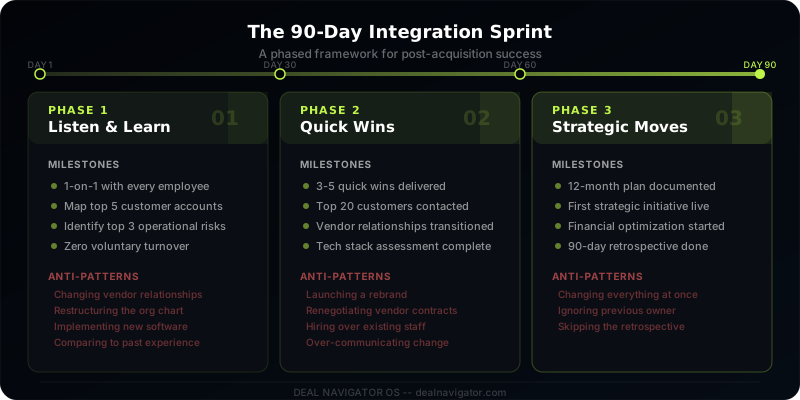
The 90-Day Integration Sprint divides your first three months into three distinct phases, each with specific objectives, milestones, and anti-patterns to avoid. The phases are sequential and non-negotiable — you cannot skip Phase 1 and jump to Phase 3 without creating organizational damage that takes months to repair.
Phase 1: Listen and Learn (Days 1-30)
Objective: Build trust, understand reality, and resist the urge to change anything.
This is the hardest phase for most acquisition entrepreneurs. You just spent months analyzing this business, negotiating the deal, and planning improvements. You have a notebook full of ideas. You are paying the debt service. Every fiber of your being wants to start optimizing.
Do not.
The single most important thing you can do in the first 30 days is listen. Talk to every employee. Talk to every major customer. Talk to every vendor. Ask the same question over and over: "What works well here, and what would you change if you could?"
Week 1: The Critical First Impressions
The all-hands meeting is the most important hour of your entire acquisition. Here is exactly what to say and what not to say:
Say this:
- "I bought this business because it is already great. My job is to make it even better."
- "Nobody is losing their job because of this transition."
- "I am here to learn from you. You know this business better than I do."
- "My door is open. If something concerns you, tell me directly."
Never say this:
- "I have big plans for changes around here."
- "At my last company, we did things differently."
- "We will be evaluating everyone's performance over the next few months."
That last one — even if you intend to evaluate performance eventually — creates immediate anxiety that drives your best people to update their resumes. According to SHRM's employee engagement research, the number one predictor of post-acquisition turnover is perceived job insecurity, not actual job insecurity.
Week 2: One-on-One Discovery
Schedule individual meetings with every employee. For small businesses (under 30 employees), meet with everyone. For larger teams, meet with every manager and a representative sample from each department.
Use this framework for each conversation:
- Their story: How long have you been here? What do you do day to day? What is the best part of working here?
- Their concerns: What worries you about the ownership change? What would make you feel better about the transition?
- Their insights: If you could change one thing about how this business operates, what would it be? What should I absolutely not change?
- Their needs: What do you need from me to do your best work?
Document every conversation. You are building an intelligence map of the organization that no amount of due diligence could have revealed.
Weeks 3-4: Operational Observation
Spend time in every part of the business. If it is a physical operation, work the floor. If it is a service business, shadow the delivery team. If it is e-commerce, watch the fulfillment process end to end.
You are looking for three things:
- Tribal knowledge — processes that only exist in one person's head
- Workarounds — places where employees have created informal solutions to broken systems
- Bright spots — things that work better than expected and should be protected
Phase 1 Milestones
- Every employee has had a one-on-one conversation with you
- You can describe the top 5 customer accounts and their relationship with the business
- You have identified the 3 biggest operational risks
- You have NOT made any changes to processes, systems, or personnel
- Employee voluntary turnover is zero
Phase 1 Anti-Patterns
| Anti-Pattern | Why It Fails | What to Do Instead |
|---|---|---|
| Changing vendor relationships | Vendors have pricing and terms built on trust with the previous owner | Introduce yourself and affirm the existing relationship |
| Restructuring the org chart | Signals that current team structure is wrong before you understand it | Observe how information and decisions actually flow |
| Implementing new software | Forces the team to learn your tools during an already stressful transition | Use what they use for at least 60 days |
| Comparing to previous experience | Implies the current team is doing it wrong | Ask questions instead of making statements |
Phase 2: Quick Wins (Days 31-60)
Objective: Build credibility by fixing the pain points everyone already knows about.
By day 31, you should have a clear picture of what is working and what is not. More importantly, you should have earned enough trust through Phase 1 that the team will be receptive to your first changes.
The key principle of Phase 2 is that you are not implementing your vision yet. You are fixing their pain points. The improvements you make in this phase should come directly from what employees and customers told you during Phase 1.
Selecting Quick Wins
A good quick win has three characteristics:
- Visible impact — the team sees the improvement immediately
- Low disruption — the change does not require retraining or process overhaul
- Employee-sourced — someone on the team asked for this
Examples of effective quick wins:
- Replacing broken equipment that the previous owner refused to fix
- Eliminating a report or meeting that everyone agrees is useless
- Fixing the one software bug that has been annoying the team for two years
- Adding a tool or resource that makes a daily task faster
- Resolving a long-standing customer complaint
Customer Communication Strategy
If you have not yet communicated the ownership change to customers, the 30-60 day window is the right time. You have enough operational understanding to answer their questions and enough credibility with the team that the message will be consistent.
For B2B customers (top 20% by revenue): Personal phone call or in-person meeting. Do not send an email. These relationships are the lifeblood of the business, and a form letter signals that you do not value them.
Here is a proven script:
"Hi [Name], I wanted to introduce myself personally. I recently acquired [Business Name] and I wanted you to hear directly from me that your account is a priority. The team you work with is staying in place, and my goal is to make your experience even better. What is working well for you, and is there anything we could improve?"
For B2B customers (remaining 80%): A professional email from you, co-signed by the previous owner if possible. Include three things: who you are, what is not changing (their point of contact, pricing, terms), and how to reach you directly.
For B2C customers: A branded announcement through your existing channels — email list, social media, in-store signage. Keep it positive and forward-looking. Customers care about one thing: will the product or service they depend on continue to be reliable?
Vendor Relationship Continuity
By day 30, you should have introduced yourself to every significant vendor. During Phase 2, formalize the relationship:
- Review every vendor contract and note expiration dates, auto-renewal clauses, and pricing terms
- Schedule a relationship meeting (not a renegotiation) with your top 10 vendors by spend
- Pay every invoice on time. This is not the moment to optimize payment terms. Your credit reputation with vendors starts now.
- Ask vendors what they need from you to maintain the relationship. They have seen ownership transitions before and they have concerns too.
Do not renegotiate vendor contracts during Phase 2. You do not have enough leverage or operational understanding to know which terms matter. That is a Phase 3 activity.
Tech Stack Assessment
Use the Phase 2 window to conduct a technology assessment, not a technology replacement. Document:
- Every piece of software the business uses and what it costs
- Who uses each tool and how critical it is to daily operations
- Integration dependencies between systems
- Contract terms and renewal dates
- Data portability — can you export your data if you switch?
This assessment informs Phase 3 decisions. Making technology changes during Phase 2 is almost always premature unless a system is actively broken and causing revenue loss. If you identified technology concerns during your initial due diligence process, Phase 2 is for scoping the fix, not implementing it.
Phase 2 Milestones
- 3-5 quick wins implemented and acknowledged by the team
- Top 20 customers personally contacted
- All vendor relationships formally transitioned to your name
- Technology assessment documented
- Employee voluntary turnover is still zero
- At least one employee has told you "things are getting better"
Phase 2 Anti-Patterns
| Anti-Pattern | Why It Fails | What to Do Instead |
|---|---|---|
| Launching a rebrand | Confuses customers and signals instability | Wait until Month 6 minimum |
| Renegotiating vendor contracts | You lack leverage and context this early | Build the relationship first, negotiate from strength later |
| Hiring your own people over existing staff | Destroys trust with the inherited team | Promote from within when possible |
| Over-communicating change | Creates change fatigue before the real changes begin | Communicate wins, not plans |
Phase 3: Strategic Moves (Days 61-90)
Objective: Implement your growth plan with the trust, knowledge, and credibility you have earned.
By day 61, you have built relationships, proven your competence through quick wins, and earned the team's confidence. Now you can implement the changes you originally envisioned when you wrote the letter of intent.
Phase 3 is where you transition from custodian to leader.
Building Your 12-Month Strategic Plan
Your first 60 days of observation and listening gave you intelligence that no pre-acquisition analysis could match. Use it to build a strategic plan organized around three pillars:
Pillar 1: Revenue Growth
- Which products or services have the highest margins and lowest customer acquisition costs?
- Are there obvious cross-sell or upsell opportunities the previous owner was not pursuing?
- What does the sales pipeline look like, and where are deals getting stuck?
- Which customer segments are growing and which are shrinking?
Pillar 2: Operational Efficiency
- Which processes have the most waste, rework, or bottlenecks?
- Where is the business over-relying on manual labor that could be automated?
- Are there vendor consolidation opportunities that would reduce costs?
- What technology investments would have the highest ROI?
Pillar 3: Team Development
- Which roles are most critical and most vulnerable (single points of failure)?
- Do you need to hire, or do you need to train and promote existing staff?
- What would a performance management system look like for this team?
- How do you create career paths that retain your best people long-term?
Making Your First Strategic Hire
If you identified a capability gap during your assessment, Phase 3 is the appropriate time to make your first strategic hire. Two rules:
-
Never hire above an existing employee without a conversation. If you are bringing in a new manager, talk to the person who was informally filling that role first. Explain why you are adding the position, how it helps them, and what their career path looks like.
-
Hire for the gap, not for comfort. Your instinct will be to hire someone you have worked with before. Resist this unless that person is genuinely the best candidate. Bringing in your own people too early signals to the existing team that they are being replaced.
Financial Optimization
By day 60, you should understand the financial mechanics of the business at a granular level. Phase 3 is when you begin optimization:
- Pricing analysis: Are you priced correctly relative to the value delivered and the competitive landscape? For service businesses, most acquisitions reveal underpricing. If you valued the business correctly and the margins are thin, pricing is likely the first lever.
- Cost structure review: Now you can renegotiate vendor contracts from a position of knowledge. You know what each vendor provides, how critical they are, and what alternatives exist.
- Working capital optimization: Tighten accounts receivable. If customers are used to paying in 60 days, begin a systematic transition to 30 days with appropriate notice.
- Debt service management: Review your acquisition financing terms and model scenarios for accelerated paydown versus reinvestment.
Phase 3 Milestones
- 12-month strategic plan documented and shared with the leadership team
- First strategic initiative launched (revenue, efficiency, or team development)
- Financial optimization plan in place with projected impact
- 90-day integration retrospective completed with the team
- Net Promoter Score baseline established for customers and employees
Phase 3 Anti-Patterns
| Anti-Pattern | Why It Fails | What to Do Instead |
|---|---|---|
| Trying to change everything at once | Overwhelms the team and creates execution chaos | Pick the highest-impact initiative and execute it completely before starting the next one |
| Ignoring the previous owner's advice | They built this business and understand its rhythms | Use their transition support period fully |
| Skipping the retrospective | You miss the chance to course-correct early | Schedule the 90-day review on Day 1 and protect the date |
The Employee Retention Playbook
Employee retention deserves special attention because it is the single highest-risk factor in your first 90 days. The cost of replacing a skilled employee is 50% to 200% of their annual salary, according to SHRM. For a small business with 10 employees, losing two key people could cost you $100,000 or more in replacement costs, lost productivity, and institutional knowledge.
Retention Actions by Week
Week 1: Announce no layoffs. Mean it.
Week 2: Complete all one-on-one meetings. Listen more than you talk.
Week 4: Identify your three most critical employees — the ones whose departure would cause the most damage. Ensure they feel valued.
Week 6: Deliver your first quick win that directly benefits the team (not just the bottom line).
Week 8: Have a follow-up conversation with every employee. Share what you have learned and what you are doing about it.
Week 10: Begin formalizing any compensation or benefits improvements you plan to make.
Week 12: Conduct the 90-day retrospective. Ask every employee: "How are you feeling about the transition?"
The Stay-Interview Framework
Do not wait for exit interviews to learn why people leave. Conduct stay interviews during Phase 1 and Phase 2:
- What do you look forward to when you come to work each day?
- What are you learning here? What do you want to learn?
- Why do you stay at this company?
- When was the last time you thought about leaving? What prompted it?
- What can I do to make your experience here better?
These questions surface retention risks before they become resignations. The data from stay interviews also informs your Phase 3 team development strategy.
Handling the Transition Period with the Previous Owner
Most acquisition agreements include a transition support period — typically 30 to 90 days where the previous owner remains available to train you and introduce you to key relationships. How you manage this period has an outsized impact on your success.
Best Practices for Owner Transition
- Set a clear schedule. Do not leave the transition period unstructured. Define specific days, hours, and objectives for the previous owner's involvement.
- Prioritize relationship introductions. The most valuable thing the previous owner can do is personally introduce you to key customers, vendors, and partners. Emails and letters are not enough for critical relationships.
- Document tribal knowledge. The previous owner carries years of context in their head — supplier quirks, customer preferences, seasonal patterns, regulatory nuances. Get it on paper before the transition period ends.
- Manage the handoff publicly. When the previous owner introduces you to a customer, they should explicitly endorse you. "I chose to sell to [your name] because I trust them to take care of you" is worth more than any marketing campaign.
- Plan the clean exit. Set a firm end date for the transition. Lingering involvement from the previous owner creates confusion about who is in charge and prevents the team from fully transferring their loyalty.
If you structured the deal with seller financing, the previous owner has a financial incentive to ensure a smooth transition. Use this alignment strategically — they want you to succeed because your success ensures they get paid.
Common Mistakes in the First 90 Days
After studying dozens of post-acquisition transitions, these are the mistakes that appear most frequently:
1. Treating the acquisition like a startup. You did not start this business. You inherited it. The systems, culture, and relationships that exist have value. Your job is to enhance them, not replace them.
2. Making promises you cannot keep. In the anxiety of the transition, new owners often over-promise — raises, new equipment, expanded benefits. Only promise what you can deliver in the next 30 days. Everything else is a goal, not a commitment.
3. Ignoring the informal power structure. Every organization has a formal org chart and an informal influence network. The person with the most institutional power is not always the person with the highest title. Identify the informal leaders early and earn their buy-in.
4. Failing to communicate enough. During periods of uncertainty, the absence of communication is interpreted as bad news. Even if you have nothing new to share, tell people that. "I do not have any updates this week, but I wanted you to know I am thinking about X and Y" is infinitely better than silence.
5. Neglecting your own transition. You are not just the new owner — you are a human being going through one of the most stressful professional transitions possible. Build support systems. Find a mentor or peer group of acquisition entrepreneurs. Take care of your physical and mental health. A burned-out owner makes bad decisions, and bad decisions in the first 90 days have compounding consequences.
The 90-Day Integration Scorecard
Use this scorecard to evaluate your progress at the end of each phase. Score each item from 1 (not started) to 5 (fully achieved):
Phase 1 Scorecard (Day 30)
| Metric | Target Score |
|---|---|
| All employees met individually | 5 |
| Top customers identified and understood | 4+ |
| Operational risks documented | 4+ |
| Zero voluntary turnover | 5 |
| Transition support period on track | 4+ |
Phase 2 Scorecard (Day 60)
| Metric | Target Score |
|---|---|
| Quick wins delivered | 4+ |
| Customer communication completed | 4+ |
| Vendor relationships transitioned | 4+ |
| Technology assessment documented | 3+ |
| Team morale stable or improving | 4+ |
Phase 3 Scorecard (Day 90)
| Metric | Target Score |
|---|---|
| Strategic plan documented | 4+ |
| First strategic initiative launched | 3+ |
| Financial optimization underway | 3+ |
| 90-day retrospective completed | 5 |
| Foundation set for months 4-12 | 4+ |
If your total score at Day 90 is above 60 (out of 75), you are in excellent position. Below 45, you have significant integration risk that needs immediate attention.
Frequently Asked Questions
Should I make changes immediately after buying a business?
No. The first 30 days should be dedicated to listening, learning, and building trust with the team. Making changes before you understand the business creates unnecessary risk and alienates employees who interpret premature changes as criticism of their work. The 90-Day Integration Sprint framework places all strategic changes in Phase 3 (days 61-90) for this reason.
How do I tell employees about the acquisition?
Hold an all-hands meeting within the first 48 hours. Be direct, transparent, and reassuring. State clearly that no jobs are at risk because of the ownership change. Explain why you bought the business (because it is great, not because it needs fixing). Then schedule individual one-on-one meetings with every employee in the following two weeks. The combination of group transparency and individual attention is the most effective approach for managing transition anxiety.
When should I replace the previous owner's systems?
Not before Day 60, and ideally not before Day 90. Use the first two months to understand why each system exists and how the team uses it. Many systems that look outdated from the outside are deeply embedded in daily workflows, and replacing them creates operational disruption that is far more expensive than it appears. Conduct a full technology assessment during Phase 2, then plan replacements as part of your Phase 3 strategic plan.
What if key employees threaten to leave during the transition?
Have an immediate, private conversation. Ask what is driving their concern. Often, the answer is uncertainty — they do not know what the future looks like under new ownership. Be specific about their role, their value to the business, and your plans for their career growth. If compensation is a factor and the employee is genuinely critical, consider a retention bonus tied to a 6 or 12-month commitment. Losing a key employee in the first 90 days costs far more than a retention bonus.
How do I handle customers who are nervous about the ownership change?
Personal contact is the answer. For your top revenue-generating customers, a phone call or in-person meeting is non-negotiable. For the broader customer base, a professional announcement emphasizing continuity — same team, same service, same commitment — is sufficient. The most effective message is co-signed by the previous owner, which provides social proof that the transition is endorsed by someone the customer already trusts.
Your First 90 Days Start Before Closing
The best post-acquisition transitions begin during the deal process. While you are conducting due diligence and negotiating terms, you should also be building your 90-day integration plan. The framework in this guide gives you the structure. The execution is yours.
If you are still in the deal-finding phase, start with our guide on how to find businesses for sale that are not listed on marketplaces. The best acquisition targets often never make it to a public listing.
The first 90 days are not about proving you are smarter than the previous owner. They are about proving you are worthy of the trust that employees, customers, and vendors are extending to you. Earn that trust methodically, and the business will reward you for years to come.
BuyBox helps acquisition entrepreneurs navigate every stage of the deal lifecycle — from sourcing and valuation through due diligence and post-acquisition integration. If you are planning your first acquisition or preparing for the transition period, the platform gives you the frameworks, checklists, and tools to execute with confidence.
Brandon Quijano
Acquisition strategist & builder of BuyBox