SBA Loan vs Seller Financing: Which Is Better for Your Acquisition?
SBA Loan or Seller Financing? The Answer Depends on One Thing
Every acquisition buyer eventually lands on the same question: should I finance this deal with an SBA loan vs seller financing? The answer is not about which option is objectively better. It is about which structure fits your deal, your timeline, and your risk tolerance. And in many cases, the best answer is both.
The SBA 7(a) loan is the most popular financing vehicle for small business acquisitions in the United States, backing over $27.5 billion in loans in fiscal year 2024 alone. Seller financing, on the other hand, is the quiet workhorse of deal-making — present in roughly 60-80% of small business transactions in some form, yet rarely discussed with the same rigor.
This guide breaks down both options head-to-head, introduces The Financing Decision Tree — a framework for choosing the right structure — and covers the hybrid approach that experienced acquirers use to get the best terms from both sides.
The best financing structure is not the cheapest one. It is the one that keeps the seller invested in your success and the bank comfortable with your risk.
Why Financing Structure Matters More Than Purchase Price
First-time buyers obsess over purchase price. Experienced buyers obsess over deal structure. Here is why: a $1M business purchased with seller financing at 6% over 5 years looks very different from the same business purchased with an SBA loan at prime+2.5% over 10 years. The monthly debt service, cash flow cushion, and risk profile are fundamentally different — even though the price tag is identical.
Your financing structure determines:
- Monthly cash flow — how much of the business's earnings service debt vs. go to your pocket
- Risk distribution — who holds the bag if the business underperforms
- Closing speed — whether you can move fast enough to beat competing offers
- Seller alignment — whether the seller has skin in the game during the transition
- Exit flexibility — how easily you can refinance, sell, or restructure down the road
If you have not already established what the business is worth, start with our guide on how to value a small business before diving into financing. Overpaying with cheap money is still overpaying.
SBA 7(a) Loans: The Gold Standard for Acquisition Financing
The SBA 7(a) loan program is the federal government's primary vehicle for small business lending. It does not lend directly — instead, it guarantees up to 85% of loans under $150,000 and 75% of loans above that amount, reducing risk for participating lenders.
For acquisition buyers, the SBA 7(a) is attractive for one reason: leverage. You can acquire a business with as little as 10% down, amortized over 10 years (or up to 25 years if commercial real estate is included). No other financing vehicle in the small business space offers that combination.
How SBA 7(a) Works for Acquisitions
- Find a participating lender. Not all banks do SBA lending. SBA Preferred Lenders (PLP) can approve loans without additional SBA review, which speeds things up considerably.
- Submit your buyer profile. The lender evaluates your credit score (minimum 680-700 for most lenders), industry experience, net worth, and liquidity.
- Provide a business valuation. The lender needs to see that the business can service the debt. Most lenders require a debt service coverage ratio (DSCR) of at least 1.25x — meaning the business generates $1.25 in cash flow for every $1.00 in annual debt payments.
- Undergo full underwriting. This is the slow part. Expect 60-90 days from application to close. The lender reviews the business financials (typically 3 years of tax returns), your personal financial statement, and the purchase agreement. For a complete breakdown of what lenders examine, see our due diligence checklist.
- Close with an SBA-approved closing attorney. The SBA has specific documentation requirements. Missing a form can delay closing by weeks.
SBA 7(a) Advantages
- Low down payment. 10% equity injection is standard. Some lenders will accept a combination of cash and seller standby notes.
- Long amortization. 10-year terms for business acquisitions, 25 years if commercial real estate is included. This keeps monthly payments manageable.
- Competitive rates. Variable rate tied to prime. As of 2026, typical acquisition loans are priced at prime + 2.25% to prime + 2.75%.
- No balloon payments. Fully amortizing — you know exactly what you owe every month for the life of the loan.
- Established process. Lenders know how to underwrite these deals. There is a playbook.
SBA 7(a) Disadvantages
- Slow. 60-90 days minimum. Some deals take 120 days or more. If the seller wants to close fast, this is a problem.
- Personal guarantee required. Anyone with 20% or more ownership must personally guarantee the loan. Your house, your savings, your personal credit are all on the line.
- Collateral requirements. The SBA requires lenders to collateralize the loan to the maximum extent possible. Business assets come first, but if those are insufficient, personal assets (including your home equity) may be pledged.
- Rigid requirements. The SBA has specific rules about equity injection sources, seller standby requirements, and business eligibility. Not every deal fits the box.
- Prepayment penalties. SBA 7(a) loans with terms of 15 years or more carry prepayment penalties: 5% in year one, 3% in year two, and 1% in year three. Shorter-term loans have no prepayment penalty, per SBA standard operating procedures.
Seller Financing: The Flexible Alternative
Seller financing is exactly what it sounds like: the seller acts as the bank. Instead of receiving the full purchase price at closing, the seller carries a promissory note for a portion of the price, and the buyer makes payments over time.
There is no standardized seller financing program. Every deal is negotiated directly between buyer and seller. This is both its greatest strength (flexibility) and its greatest weakness (complexity). If you are new to negotiating these terms, our guide on seller financing negotiation tactics covers the mechanics in detail.
How Seller Financing Works
- Negotiate the terms in the LOI. The promissory note amount, interest rate, term, payment schedule, and security interest are all negotiable. For LOI best practices, see how to write a letter of intent.
- Structure the note. Most seller notes are structured with monthly payments, a fixed interest rate, and a balloon payment at the end of the term (typically 3-7 years).
- Secure the note. The seller typically takes a security interest in the business assets — and sometimes a personal guarantee from the buyer, though this is negotiable.
- Close with standard purchase agreement documentation. No SBA bureaucracy. No bank underwriting. Just buyer, seller, and their attorneys.
- Make payments. The buyer makes monthly payments to the seller per the note terms. The seller reports the interest income; the buyer deducts it. The IRS provides guidance on installment sales that both parties should understand.
Seller Financing Advantages
- Speed. 30-45 days from LOI to close is realistic. No bank committee, no SBA review, no third-party appraisal delays.
- Flexibility. Everything is negotiable — interest rate, term, payment schedule, grace periods, performance-based adjustments.
- Seller alignment. When the seller carries a note, they have a financial interest in your success. They are more likely to support the transition, introduce you to key relationships, and not disappear on day one.
- Lower qualification bar. No minimum credit score. No DSCR requirements imposed by a bank. The seller evaluates you as a buyer, not as a loan applicant.
- Creative structuring. You can structure earnouts, performance-based interest rate reductions, seasonal payment adjustments — things no bank will do.
Seller Financing Disadvantages
- Higher interest rates. Sellers typically want 5-8% on their notes, which can be higher than SBA rates depending on the prime rate environment.
- Shorter terms. Most seller notes are 3-7 years, meaning higher monthly payments and less cash flow cushion compared to a 10-year SBA amortization.
- Larger down payment. Sellers often want 20-30% down to mitigate their risk. Some will accept 10%, but that requires strong buyer credentials and solid business fundamentals.
- Balloon payment risk. Many seller notes include a balloon payment at year 3-5. If you cannot refinance by then, you have a problem.
- Relationship dependency. If the relationship with the seller deteriorates, payment disputes can get ugly. A well-drafted promissory note with clear default provisions is essential.
Head-to-Head: SBA Loan vs Seller Financing Comparison
| Factor | SBA 7(a) Loan | Seller Financing |
|---|---|---|
| Interest Rate | Prime + 2-3% (variable) | 5-8% (typically fixed) |
| Loan Term | 10 years (25 with real estate) | 3-7 years |
| Down Payment | 10% minimum | 10-30% (negotiable) |
| Time to Close | 60-90 days | 30-45 days |
| Personal Guarantee | Required (20%+ owners) | Negotiable |
| Collateral | Business + personal assets | Business assets (negotiable) |
| Prepayment Penalty | Yes (loans 15+ years) | Rarely |
| Credit Score Required | 680-700+ | No minimum |
| DSCR Requirement | 1.25x minimum | None (seller's discretion) |
| Monthly Payment (on $500K) | ~$5,800/mo (10yr, 8.5%) | ~$9,800/mo (5yr, 6%) |
| Total Interest Paid ($500K) | ~$196,000 (10yr) | ~$79,000 (5yr) |
| Seller Alignment | Low (seller gets paid at close) | High (seller carries risk) |
| Regulatory Burden | High (SBA compliance) | Low (private agreement) |
The monthly payment difference is significant. On a $500K note, the SBA loan's 10-year amortization gives you roughly $4,000 more in monthly cash flow compared to a 5-year seller note. That cash flow cushion can mean the difference between surviving your first year and defaulting.
But total interest tells a different story. The shorter seller note means you pay less interest overall — $79,000 vs $196,000 in this example. If your business has strong enough cash flow to handle the higher payments, seller financing is cheaper in absolute terms.
The Financing Decision Tree
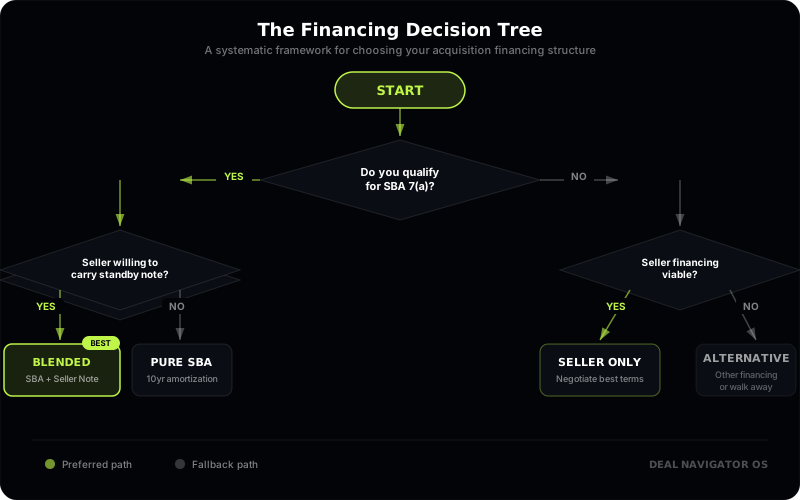
Most guides give you a pros-and-cons list and leave you to figure it out. That is not useful when you are staring at a real deal with a real deadline. The Financing Decision Tree gives you a repeatable framework for choosing the right structure.
How to Use the Decision Tree
Step 1: Do you qualify for SBA financing?
This is the threshold question. To qualify, you need:
- Credit score above 680 (700+ preferred)
- Relevant industry or management experience
- A business that generates enough cash flow for 1.25x DSCR
- 10% minimum equity injection (cash, not borrowed)
- The business must meet SBA size standards
If you answer No — skip to Step 4.
If you answer Yes — proceed to Step 2.
Step 2: Is the seller willing to carry a standby note?
Here is where it gets interesting. Even when you have SBA financing, most experienced buyers ask the seller to carry a note for 10-20% of the purchase price on "full standby" — meaning no payments for the first 2 years, then interest-only, then amortizing.
The SBA actually encourages this structure because it reduces the lender's risk and demonstrates the seller's confidence in the business. The seller standby note cannot be included in the buyer's equity injection calculation, but it reduces the total amount financed through the SBA.
If the seller says Yes — you have the best of both worlds: a Blended Structure (SBA + Seller Note). This is the optimal outcome for most deals.
If the seller says No — proceed with Pure SBA Financing. You will need the full 10% equity injection in cash and will finance the remaining 90% through the SBA lender.
Step 3: Structure the blended deal.
A typical blended structure looks like this:
- 10% buyer equity injection (cash)
- 70-80% SBA 7(a) loan (10-year term)
- 10-20% seller note (standby terms)
This structure optimizes for low monthly payments (SBA amortization), seller alignment (skin in the game), and manageable equity requirements (10% cash).
Step 4: Is seller financing viable?
If you do not qualify for SBA — or if the deal does not fit SBA parameters (too small, wrong industry, timeline too tight) — the question becomes whether the seller will finance the deal directly.
Seller financing viability depends on:
- The seller's need for immediate cash (estate sales and retirement deals are more flexible)
- The business's cash flow strength (can it support the higher payments of a shorter term?)
- Your relationship with the seller and their confidence in your ability to operate
- Tax considerations — installment sales can provide significant tax advantages for the seller under IRS Publication 537
If seller financing is viable — structure a seller-only deal with the best terms you can negotiate.
If seller financing is not viable — you need to explore alternative financing (private equity, search fund investors, ROBS 401(k), or partner equity) or walk away from this particular deal.
The Blended Structure: Why Experienced Buyers Use Both
According to BizBuySell's annual Insight Report, deals that include a seller note alongside bank financing close at a 23% higher rate than pure bank-financed deals. There is a reason for this: the blended structure aligns incentives better than either option alone.
How a Blended Deal Works in Practice
Consider a $1.2M laundromat acquisition:
- Purchase Price: $1,200,000
- Buyer Equity Injection: $120,000 (10%)
- SBA 7(a) Loan: $960,000 (80%) at prime + 2.5%, 10-year term
- Seller Note: $120,000 (10%) at 5%, 2-year standby then 5-year amortization
The SBA monthly payment is approximately $11,100. For the first 2 years, there is no seller note payment at all — giving the buyer maximum cash flow during the critical transition period. After year 2, the seller note payment of approximately $2,260/month kicks in. By that point, the buyer should have stabilized operations and grown revenue enough to handle the additional obligation.
The seller benefits because:
- They receive $120,000 cash at close (buyer equity)
- They receive $960,000 from the SBA lender at close
- They earn 5% interest on their $120,000 note
- They have a security interest in the business as collateral
- The tax benefit of spreading $120,000 in gains over 7 years can be significant
The buyer benefits because:
- Only $120,000 cash out of pocket (10%)
- Maximum cash flow in years 1-2 (no seller note payments)
- The seller has $120,000 at risk, motivating them to support the transition
- Lower total monthly payment vs. financing the entire $1.2M through SBA
When the Blended Structure Does Not Work
The blended structure falls apart when:
- The seller needs all cash at close. Divorce settlements, estate liquidations, or sellers with their own debt obligations may require full payment.
- The SBA lender rejects the seller note terms. Some lenders have stricter standby requirements than others. Always confirm with your lender before promising standby terms to the seller.
- The business cannot support both payments. If the DSCR is barely 1.25x with the SBA loan alone, adding a seller note makes the deal too tight.
When SBA is the Better Choice
Choose pure SBA financing when:
-
You qualify and the seller wants all cash at close. Some sellers — particularly those in financial distress or going through major life changes — need the full purchase price wired at closing. SBA gives you the leverage to make that happen with only 10% down.
-
You want the longest possible amortization. If cash flow is tight, the 10-year (or 25-year with real estate) amortization from SBA is unbeatable. No seller is giving you a 10-year note.
-
You need the credibility of institutional backing. In competitive deal situations, an SBA pre-approval letter from a reputable lender signals that you are a serious, vetted buyer. This matters when sellers are evaluating multiple offers.
-
The business includes commercial real estate. When the deal includes the building, SBA financing at 25-year amortization makes the numbers work in ways that seller financing simply cannot match.
When Seller Financing is the Better Choice
Choose seller financing when:
-
Speed is critical. If the seller has another offer and wants to close in 30 days, you cannot wait for SBA underwriting. Seller financing lets you move at the speed of negotiation, not the speed of bureaucracy.
-
You do not qualify for SBA. Maybe your credit score is 650, maybe you lack industry experience, maybe the business is too small for SBA lenders to care about. Seller financing has no institutional gatekeepers.
-
You want maximum negotiating leverage. With seller financing, every term is negotiable. You can structure interest rate reductions tied to performance, seasonal payment adjustments, or graduated payment schedules that start low and increase as you grow the business.
-
Seller alignment is critical to the deal's success. If the business is highly relationship-dependent — the seller's personal relationships drive revenue — you want the seller financially invested in your success for 3-5 years. A seller note accomplishes this. SBA does not.
-
The deal has unusual characteristics. Asset-heavy businesses, seasonal businesses, or businesses with customer concentration issues may not fit cleanly into SBA underwriting boxes. Seller financing adapts to the deal; SBA makes the deal adapt to its requirements.
Real Deal Structures: Three Examples
Example 1: Pure SBA — Manufacturing Business
Business: CNC machine shop, $2.1M SDE, asking $5.5M including real estate Buyer: Former operations VP with 12 years in manufacturing, 780 credit score, $550K liquidity Structure: SBA 7(a) loan for $4.95M (90%), buyer equity of $550K (10%), 25-year term at prime + 2.25% Monthly payment: ~$33,400 Why SBA: The real estate component made 25-year amortization available. The buyer's strong credentials made approval straightforward. The seller wanted all cash because they were retiring to Portugal.
Example 2: Pure Seller Financing — Service Business
Business: Commercial cleaning company, $280K SDE, asking $700K Buyer: First-time buyer, 660 credit score, $140K savings, 5 years managing cleaning crews Structure: Seller note for $560K (80%) at 6.5% over 5 years with 6-month interest-only period, buyer down payment of $140K (20%) Monthly payment: ~$4,400 (after interest-only period ends) Why seller financing: The buyer's credit score was below SBA minimums. The deal was too small for most SBA lenders to prioritize. The seller was retiring and wanted the tax advantages of an installment sale. The 6-month interest-only period gave the buyer time to stabilize operations.
Example 3: Blended — E-commerce Business
Business: Specialty e-commerce brand, $420K SDE, asking $1.3M (no real estate) Buyer: Former Amazon category manager, 720 credit score, $160K cash Structure: SBA loan for $1M (77%) at prime + 2.5% over 10 years, seller note for $140K (11%) at 5% on 2-year standby then 3-year amortization, buyer equity of $160K (12%) Monthly payment: SBA: ~$11,600; Seller note (after standby): ~$4,200 Why blended: The buyer wanted the seller to stay involved through the brand transition. The seller was willing to carry a note because they believed in the buyer's e-commerce expertise. The standby period ensured the buyer had maximum cash flow while learning the business's supply chain and vendor relationships.
Common Mistakes in Acquisition Financing
Mistake 1: Choosing Based on Interest Rate Alone
A 5% seller note sounds cheaper than an 8.5% SBA loan. But if the seller note is 5 years and the SBA loan is 10, the SBA loan gives you $4,000+ more in monthly cash flow. Monthly cash flow determines whether you survive year one. Total interest cost is a secondary concern.
Mistake 2: Ignoring the Seller's Motivation
A seller who needs to close in 30 days and wants cash is not going to carry a note, no matter how persuasive your pitch. Read the seller's motivation before structuring your offer. Morgan & Westfield's guide to seller motivations is a solid resource for understanding what drives sellers.
Mistake 3: Skipping the SBA Pre-Approval
Even if you plan to use seller financing, get an SBA pre-approval letter before negotiating. It gives you leverage: "I have bank financing available, but I would prefer to structure something with you directly." The seller knows you have a backup plan, which changes the negotiation dynamic entirely.
Mistake 4: Structuring a Seller Note That Starves the Business
If the business generates $25K/month in cash flow and your combined debt service is $22K/month, you have a $3K cushion. One bad month — a lost customer, an equipment failure, a seasonal dip — and you cannot make payments. Structure the deal so you have at least a 1.25x coverage ratio on all debt service combined.
Mistake 5: Failing to Document Seller Note Terms Properly
Seller financing is a private agreement, but that does not mean it should be casual. Every seller note needs: a promissory note, a security agreement, UCC-1 filing, default provisions, cure periods, and acceleration clauses. Hire an attorney. This is not a handshake deal.
Tax Implications: What Both Sides Need to Know
Financing structure has significant tax consequences for both buyer and seller.
For the buyer:
- Interest payments on both SBA loans and seller notes are tax-deductible business expenses
- The allocation of purchase price between assets and goodwill affects your depreciation schedule
- SBA loan origination fees and closing costs may be amortizable
For the seller:
- An installment sale (seller financing) allows the seller to spread capital gains over the term of the note, potentially reducing total tax liability
- The IRS installment sale rules under Publication 537 govern how gains are recognized
- Sellers receiving all cash at close (SBA scenario) recognize the full gain in the year of sale
- Sellers should consult a tax advisor to compare the after-tax proceeds of cash-at-close vs. installment sale scenarios
This tax difference can be a powerful negotiating tool. If you can show the seller that carrying a note saves them $50,000-$100,000 in taxes, they may accept a lower interest rate or more favorable terms in exchange.
Frequently Asked Questions
Can you combine SBA and seller financing?
Yes — and it is one of the most common structures in small business acquisitions. The SBA allows seller notes as part of the deal structure, but the seller note must typically be on "full standby" for at least 24 months (no payments during that period). After the standby period, the note can begin amortizing. The seller note cannot count toward the buyer's 10% equity injection — that must be cash. Confirm specific standby requirements with your SBA lender, as they vary.
Which is faster to close?
Seller financing is significantly faster. A seller-financed deal can close in 30-45 days from signed LOI. SBA deals typically take 60-90 days, and complex deals can stretch to 120 days. If speed is your primary concern — for example, competing against another buyer — seller financing gives you a major advantage.
What if the seller refuses to finance?
If the seller will not carry a note and you do not qualify for SBA, your options are: (1) find a private lender or search fund investor willing to back the deal, (2) use a ROBS (Rollover for Business Startups) strategy to use retirement funds as equity, (3) bring in a partner who contributes the capital or creditworthiness you lack, or (4) walk away and find a deal where the financing structure works. Not every deal is your deal.
How does seller financing affect purchase price?
Seller-financed deals often trade at a 5-15% premium over all-cash deals. The logic is simple: the seller is providing financing, accepting risk, and deferring income — they expect to be compensated for that. However, this premium can be offset by negotiating more favorable terms (lower interest rate, longer term, interest-only periods). The total cost of acquisition — price plus interest — is what matters, not the sticker price alone.
Does seller financing require a down payment?
Almost always, yes. Sellers want to see that the buyer has meaningful equity at risk. The typical range is 10-30% down, with 20% being the most common. Some sellers will accept 10% for exceptionally strong buyers with relevant experience. Very few sellers will accept less than 10% — at that point, the buyer has little to lose by walking away, which makes the seller uncomfortable.
Making the Decision: A Practical Framework
Stop thinking about SBA vs seller financing as an either-or choice. Think about it as a spectrum:
On one end: Pure SBA — maximum leverage, minimum equity, longest amortization, slowest close, least seller alignment.
On the other end: Pure seller financing — maximum speed, maximum flexibility, shortest term, highest seller alignment.
In the middle: Blended structures — optimized for the specific deal, balancing cash flow, speed, and alignment.
The right answer depends on three things:
- Your financial profile. Do you qualify for SBA? Do you have enough cash for the down payment either way?
- The seller's motivation. Do they need cash at close? Are they open to carrying a note? Will tax benefits persuade them?
- The business's cash flow. Can it support the debt service of a shorter seller note? Or does it need the breathing room of a 10-year SBA amortization?
Run the Financing Decision Tree. Stress-test the monthly payments against a 20% revenue decline. Talk to an SBA lender and get pre-approved even if you prefer seller financing. Then make your decision based on the deal in front of you, not on a blog post's generic advice.
Navigate Financing Decisions with Confidence
Choosing the right financing structure is one of the highest-leverage decisions in any acquisition. Get it right, and you set yourself up with manageable debt service, seller support during the transition, and cash flow to invest in growth. Get it wrong, and you spend the next five years fighting for survival instead of building value.
BuyBox gives you the tools to model financing scenarios, compare structures side-by-side, and stress-test your deal against downside scenarios — so you walk into negotiations knowing exactly what works for your numbers, not guessing. The Financing Decision Tree is just one of the frameworks built into the platform to help you make high-stakes decisions with clarity.
The best deal is the one where the financing structure works for everyone — buyer, seller, and lender. Use the framework, run the numbers, and structure a deal that lets you sleep at night.
Brandon Quijano
Acquisition strategist & builder of BuyBox